Blog

All Passport Toyota News New Vehicles New Toyota Cars For Sale Suitland Toyota Dealer Suitland New Toyota Cars For Sale Suitland Toyota Service Car Maintenance Tips Community Suitland Used Cars Toyota Information Travel Destinations Vehicle Safety Tips Travel Safety Tips

Toyota Safety Sense™ comes standard on many new Toyotas

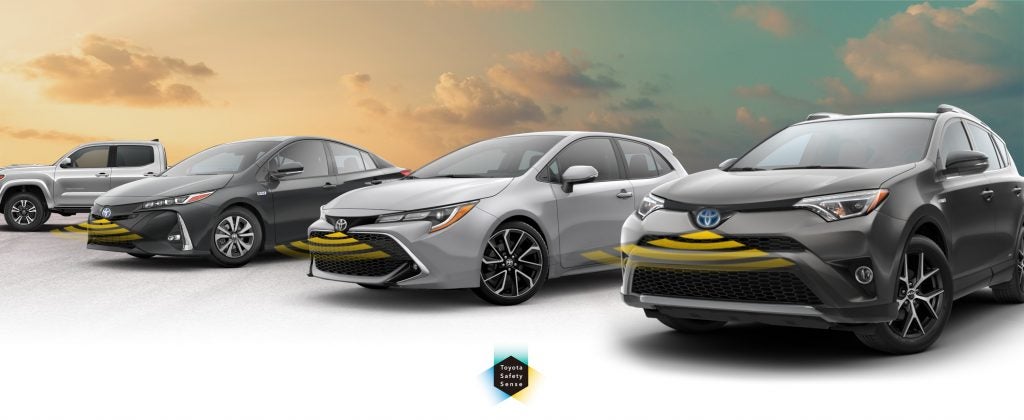
Toyota Safety Sense™ (TSS)  is a bundle of active safety features included on many new Toyota vehicles at no additional cost. These innovative features were designed to help protect you and your passengers from harm. Pre-Collision System with Pedestrian Detection This integrated camera and radar system is designed to help reduce the likelihood of colliding with a preceding car or pedestrian. Also available with Bicyclist Detection more Lane Departure Alert A camera on your windshield may help you avoid the consequences of unintended lane departure by alerting you when it senses that you’ve veered from your lane. Also available with Steering Assist  and Road Edge Detection Automatic High Beams A camera on your windshield aids nighttime driving by using a camera to detect headlights and taillights of preceding vehicles, and toggling accordingly between high and low beams. Dynamic Radar Cruise Control This high-tech cruise control uses radar behind the Toyota badge plus a camera on the windshield designed to adjust your speed, helping you maintain a preset distance from the car in front of you. Also available with Full-Speed Range Dynamic Radar Cruise Control Road Sign Assist new Using a forward-facing intelligent camera, Road Sign Assist (RSA)  is designed to detect speed limit signs, stop signs, do not enter signs and yield signs, and display them on the MID.* *All vehicle actions must be driver-initiated and are not automated. Lane Tracing Assist new When Full-Speed Range Dynamic Radar Cruise Control (DRCC)  is enabled and lane markers are visible, Lane Tracing Assist (LTA)  uses the lines on the road and preceding vehicles to help keep the vehicle centered and in its lane. Click here for details.

Toyota and Uber Extend Collaboration to Automated Vehicle Technologies

Toyota Motor Corporation (TMC) and Uber Technologies, Inc. (Uber) today announced that they have agreed to expand their collaboration with the aim of advancing and bringing to market autonomous ride-sharing as a mobility service at scale. To accomplish this, technology from each company will be integrated into purpose-built Toyota vehicles to be deployed on Uber’s ride-sharing network. Separately, Toyota is investing $500 million in Uber. “Combining efforts with Uber, one of the predominant global ride-sharing and automated driving R&D companies, could further advance future mobility,” said Shigeki Tomoyama, executive vice president, TMC, and president, Toyota Connected Company. “This agreement and investment marks an important milestone in our transformation to a mobility company as we help provide a path for safe and secure expansion of mobility services like ride-sharing that includes Toyota vehicles and technologies.” more As Uber and Toyota look ahead to a self-driving future, this partnership will be critical in realizing self-driving technology at scale. Uber and Toyota anticipate that the mass-produced autonomous vehicles will be owned and operated by mutually agreed upon third party autonomous fleet operators. “The deal is the first of its kind for Uber, and signals our commitment to bringing world-class technologies to the Uber network,” said Dara Khosrowshahi, Uber’s CEO. “Our goal is to deploy the world’s safest self-driving cars on the Uber network, and this agreement is another significant step towards making that a reality. Uber’s advanced technology and Toyota’s commitment to safety and its renowned manufacturing prowess make this partnership a natural fit. I look forward to seeing what our teams accomplish together.” The initial “Autono-MaaS” (autonomous-mobility as a service) fleet will be based on Toyota’s Sienna Minivan platform. Uber’s Autonomous Driving System and the Toyota Guardian automated safety support system will both be integrated into the Autono-MaaS vehicles. Toyota will also utilize its Mobility Services Platform (MSPF), its core information infrastructure for connected vehicles. Pilot-scale deployments will begin on the Uber ride-sharing network in 2021. “Uber’s automated driving system and Toyota’s Guardian system will independently monitor the vehicle environment and real-time situation, enhancing overall vehicle safety for both the automated driver and the vehicle,” said Dr. Gill Pratt, Toyota Research Institute CEO and TMC Fellow. “We look forward to this partnership accelerating both companies’ development and deployment of automated driving technology.” Toyota’s investment in Uber and the proposed collaboration are subject to standard regulatory approvals.

Happy Labor Day Weekend from all of us at Passport Toyota

Labor Day is a day to appreciate the hard work that Americans put in throughout the year. We hope you enjoy the Labor Day cookouts or parades. Happy Labor Day Weekend!

Ready to trade up your vehicle? Passport Toyota makes it easy to calculate you payment online

The best place to buy! As a premiere dealership, we have a huge selection of new and used vehicles to choose from. At Passport Toyota, customers can enjoy special vehicle offers every day. We offer parts and service, an online inventory and outstanding financing options. Click here to estimate a a payment.

Buy 3 tires, Get the 4th for $1 at Passport Toyota

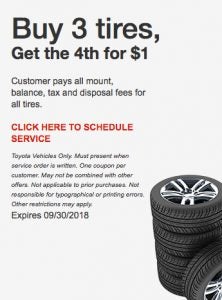
Buy 3 tires, Get the 4th for $1 Customer pays all mount, balance, tax and disposal fees for all tires. CLICK HERE TO SCHEDULE SERVICE Toyota Vehicles Only. Must present when service order is written. One coupon per customer. May not be combined with other offers. Not applicable to prior purchases. Not responsible for typographical or printing errors. Other restrictions may apply. Expires 09/30/2018

Passport Toyota is open on Labor Day, Don't Miss our Labor Day Sales Event

Labor Day Sales Event Open Sunday, Sept. 2nd NOON to 5PM Open Monday, Labor Day 9Am to 8PM Click here view Labor Day Sales Event

2018 Toyota Prius Remains A Hybrid Benchmark

Around the world, its name is synonymous with “hybrid.” Almost two decades after the first Toyota Prius was introduced in the U.S., hybridization has become common, and the Prius still leads in North American hybrid sales. It’s also one of the world’s most fuel-efficient vehicles without a plug, with EPA-estimated 58 city / 53 highway / 56 combined MPG fuel economy ratings (Prius Two Eco). For the 2018 model year, Prius Four and Four Touring grades receive a new standard 11.6-inch high-definition multimedia display. The tablet-like operation of the vertically-oriented screen provides drivers with easy access to major functions and allows navigation graphics to be brightly visible. Drivers and front passengers will find the pinch and zoom functionality familiar, speaking to the enhanced premium touch that the screen brings to these grades. Toyota offers the 2018 Prius in seven model grades, each one equipped as standard with Toyota Safety Sense P (TSS-P). Using millimeter-wave radar and a monocular camera sensor to help detect a pedestrian, a vehicle, and lane markers in the surrounding area, TSS-P provides a comprehensive bundle of active safety features designed to help protect drivers and passengers from harm and includes: Pre-Collision System with Pedestrian Detection (PCS w/ PD), Lane Departure Alert with Steering Assist (LDA w/ SA), Automatic High Beams (AHB), and Full-Speed Range Dynamic Radar Cruise Control (DRCC). An available Prius Appearance Package adds additional flair with two-tone black and gunmetal front and rear bumpers, piano black side skirt rocker panels, and 17-inch 5-spoke alloy wheels with gunmetal inserts on the Three and Four Touring grades. Common among all Prius models is a premium interior with a wrap-around dash design, form-hugging seats, easy-to-use controls and exemplary visibility. With up to 65.5 cubic feet of cargo space, Prius provides flexibility in the gear on board. Whether it’s farmer’s market finds, sports gear or supermarket hauls, Prius has it covered. more Most Efficient Prius Ever Every generation of the Prius has one key element in common: it exceeded the fuel efficiency of the previous generation. The latest version of its Hybrid Synergy Drive combines the output of a 1.8-liter 4-cylinder gasoline engine and two motor/generators through an electronically controlled planetary-type continuously variable transmission (CVT). Shift-by-wire technology, which uses electric signals to transmit shift operations, offers light, fingertip operation from the dash-mounted shifter. The regenerative brake system switches the motor into a generator to recover the wheels’ kinetic energy as electrical power, storing it in the hybrid battery. The fourth-generation Prius uses smaller, lighter hybrid components than before, including a lithium-ion hybrid battery that replaced the nickel-metal hydride battery (excluding the Prius One and Two standard grade). The battery’s smaller size and lower profile allow it to be packaged under the rear seat, rather than beneath the luggage area, yielding more cargo space. The Prius Two Eco grade provides the highest fuel efficiency thanks to its lighter weight and further optimized aerodynamics. Fuel Economy Factors The electric motors and battery don’t get all the credit for the high fuel economy in the Prius. The internal combustion engine (I.C.E.) does its part, too. The 2ZR-FXE 1.8-liter 4-cylinder gasoline engine achieves more than 40 percent thermal efficiency, thanks to reduced internal friction and improved combustion. It’s also quieter than the previous generation’s engine. Toyota found extra efficiency by cooling the Exhaust Gas Recirculation (EGR) system, and by using exhaust heat recirculation to quickly bring engine coolant up to optimal temperature. Because the Prius, under certain circumstances, can operate in battery mode alone, it incorporates a Vehicle Proximity Notification System (VPNS) to help alert pedestrians and cyclists. A small in-vehicle speaker emits a low but noticeable warning tone when traveling below approximately 15 mph, and the sound changes with vehicle speed. Beating the Wind The newest-generation Prius cheats the wind without cheating passengers out of room. The vehicle’s sleek body yields a 0.24 coefficient of drag (Cd), among the lowest of current production passenger cars. Aerodynamic efficiency is supported by such details as an automatic grille shutter that reduces drag by closing when airflow to the radiator is not needed. Aero stabilizing fins on the underfloor covers, front quarter window garnish and tail lamps likewise keep air moving in a smooth pattern. High Visibility Prius lighting is as advanced as it looks. Standard Bi-LED headlamps dominate the striking front fascia, and the rear combination lamps echo the design theme. Seeing out of the Prius is easier than ever, too. The design gives a clear view to the rear, thanks to larger rear door glass and larger fixed rear quarter windows. A backup camera comes standard on all grades, and, as on the previous model, a full-width glass panel beneath the rear spoiler aids rearward visibility. Toyota’s New Global Architecture (TNGA) Beneath the Prius’ dramatic bodylines is the solid foundation of Toyota’s New Global Architecture (TNGA). In this current-generation Prius, the platform introduced a new high-strength body structure, double-wishbone style multi-link rear suspension and a lower center of gravity. All combine to yield a highly engaging driving experience while also providing a markedly smoother and quieter ride than the previous generation. The gasoline engine, electric motor and seating positions are lower than in previous models to increase front and rear head room while at the same time achieving a low, aerodynamic stance. The TNGA platform’s structural strength greatly contributes to the high level of handling responsiveness, steering feel and ride quality in the Prius. Hot-stamped and high tensile steels, which allow for intricate forms that are both lightweight and strong, are used extensively throughout the body. Aluminum components, including the hood and rear doorframes and brake calipers, help keep vehicle weight in check. Innovative fastening methods, including laser screw welding and advanced adhesives, contribute to structural strength. Sophisticated Suspension A double-wishbone style multi-link rear suspension, seen on some of the world’s best sport sedans, is also under the Prius. As in those cars, this configuration endows the Prius with outstanding ride quality and handling agility. The design also maximizes trunk space. The Prius Touring grades take full advantage of the suspension’s inherent handling benefits by using special tuning and 17-inch wheels with 215/45R17 tires. On other grades, light-alloy 15 x 6.5-inch wheels wear aerodynamic wheel covers to reduce drag and wind noise. On all Prius models, low-rolling resistance tires are optimized for grip. Step on the brake pedal in the Prius, and instead of a cable, foot pressure signals the Electronically Controlled Brake System to apply appropriate braking force through the active hydraulic brake booster. The system coordinates control between the hybrid system’s regenerative braking and the hydraulic brake force to provide optimal performance and feel. Information Central Inside the Prius, the intuitive concept of previous models continues, anchored by a central gauge panel. The panel features dual 4.2-inch full-color TFT (Thin Film Transistor) multi-information displays, and their content can be changed using steering wheel controls. The display background color changes depending on the selected drive mode. With Power mode selected, the background appropriately glows red. Choosing Normal mode brings on a soothing blue glow. The display provides a multitude of readouts for hybrid energy information and much more, and the driver can choose how much information to receive by selecting either Simple or Segmented display modes. Simple mode shows a large vehicle speed display, remaining fuel, drive mode indicator, outside temperature, odometer functions and cruising range. The Segmented display presents more detail about hybrid operation, including instantaneous fuel economy, hybrid battery state of charge and a suite of ECO functions to encourage efficient driving habits. A driving support display shows the status of features such as Full-Speed Range Dynamic Radar Cruise Control, Lane Departure Alert and other systems. Quiet, Please The Prius’ hybrid powertrain runs very quietly, and aerodynamic design blunts wind noise. A sound-insulating laminated windshield and numerous sound absorbers in the dash structure reduce noise intrusion. Higher-grade models feature sound-insulating laminated front door glass, as well. The carpeting is backed by a thick silencer pad, and a urethane-based headliner, along with the ribbed structure of the front pillar trim, helps absorb sound. Keeping it Cool Depending on model grade, the tilt and telescoping steering wheel comes wrapped in urethane or SofTex synthetic leather that features surface temperature-regulating properties to make it feel more comfortable in hot or cold weather. Even the air conditioning system, which uses a quiet electric compressor, works intelligently. The Smart-flow (S-FLOW) mode directs airflow only to seated occupants to conserve energy and maximize comfort. In the Prius Two Eco grade, heat-insulating IR-cut windshield glass substantially reduces the transmission of infrared rays, enhancing interior comfort and also reducing the air conditioning system’s workload. In cold weather, a ceramic-type heater warms the cabin quickly. Entune Multimedia and Wireless Charging The Prius is all high-tech inside, as well, connecting with devices and music through its Entune Audio systems. Wireless charging (except base Prius One, Two, and Two Eco grades) works with Qi-compatible phones or other devices. The standard Entune Audio system on the Prius One, Prius Two, and Prius Two Eco grades includes the Entune Multimedia Bundle with a 6.1-inch touch-screen display, AM/FM CD player, six speakers, auxiliary audio jack, USB 2.0 port with iPod connectivity and control, advanced voice recognition, hands-free phone capability, phone book access and music streaming via Bluetooth wireless technology, plus Siri Eyes Free mode and an integrated backup camera display. Moving up to the Prius Three and Prius Three Touring grades, customers will enjoy Entune Premium Audio with Integrated Navigation and Entune App Suite, which includes all the previously-mentioned audio features plus a 7-inch high resolution touch-screen with split screen display, Entune App Suite, HD radio, HD predictive traffic and doppler weather overlay, AM/FM cache radio, SiriusXM All Access Radio with 3-month complimentary trial and Gracenote album cover art. Taking the multimedia experience to a premium one, the Prius Four and Prius Four Touring grades come standard with an 11.6-inch high-resolution, vertically-oriented screen that operates similarly to other touchscreen mobile devices and tablets. As part of a package, the Prius Four and Four Touring grades exclusively offer the Entune Premium JBL Audio system with Integrated Navigation and App Suite. To all features of the base and mid-grade systems, it adds 10 JBL GreenEdge Speakers in six locations creating a personal concert hall on wheels. The Entune App Suite includes Destination Search, iHeartRadio, MovieTickets.com, OpenTable, Pandora, Facebook Places, Yelp and Slacker Radio plus real-time info including traffic, weather, fuel prices, sports and stocks. Access to Entune App Suite is subscription free. (See toyota.com/entune for details.) Push (Button) to Park The Prius can even help park itself. When activated, available Intelligent Parking Assist (IPA) uses ultrasonic wave sensors to automatically steer the Prius into – or out from – parallel parking spaces, or reverse it into a perpendicular space. The Toyota-first Intelligent Clearance Sonar provides visible and audible warnings if the driver gets too close to detected obstacles on the vehicle’s sides – an excellent tool for navigating tight parking garages, for example. A full array of supplemental restraint system (SRS) airbags includes a driver and front passenger Advanced Airbag System; driver and front passenger side airbags; front and rear curtain airbags; a driver knee airbag, and a front passenger seat cushion airbag. Peace of Mind Warranty Protection Toyota’s 36-month/36,000 mile basic new-vehicle warranty applies to all components other than normal wear and maintenance items. Additional 60-month warranties cover the powertrain for 60,000 miles and against corrosion with no mileage limitation. The hybrid-related components, including the HV battery, battery control module, hybrid control module and inverter with converter, are covered for eight years/100,000 miles. The Prius also comes standard with ToyotaCare, a complimentary plan covering normal factory-scheduled maintenance for two years or 25,000 miles, whichever comes first. And, exclusive for Prius, three years (over the normal two) of 24-hour roadside assistance.

Take a peek at the 2019 Avalon Interior and its features

Watch to learn about the premium interior of the all-new 2019 Avalon! Click here to shop our 2019 Toyota Avalon models.

Lease the Toyota Corolla for only $149 per month or Purchase with $1,500 Customer Cash at Passport Toyota

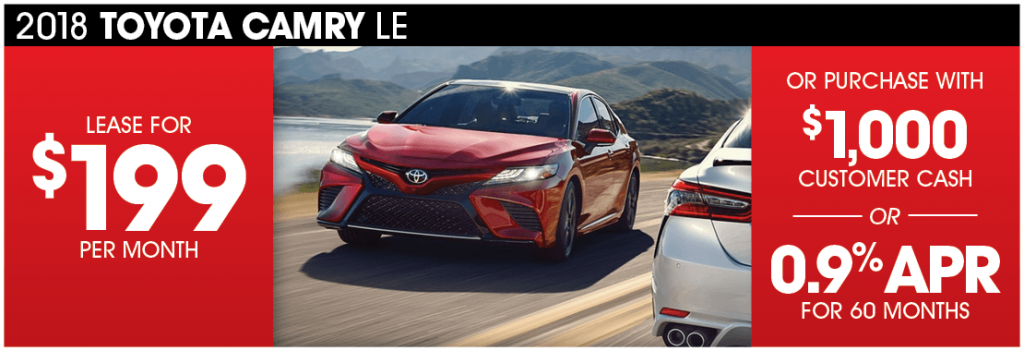
Lease the Toyota Corolla LE for only $149 per month or Purchase with $1,500 Customer Cash or 0.9% APR for 60 months. Click here to view all eligible vehicles. EXCLUDES LIFTBACKS. 0.9% APR FINANCING UP TO 60 MONTHS AVAILABLE TO QUALIFIED BUYERS THRU TOYOTA FINANCIAL SERVICES.  TOTAL FINANCED CANNOT EXCEED MSRP PLUS OPTIONS, TAX, TITLE, LICENSE AND DEALER DEALER PROCESSING FEE OF $300 (NOT REQUIRED BY LAW).  60 MONTHLY PAYMENTS OF $17.05 FOR EACH $1000 BORROWED. NOT ALL BUYERS WILL QUALIFY.  OFFER MAY NOT BE COMBINED WITH OTHER OFFERS UNLESS SPECIFIED OTHERWISE. DEALER FEES ARE EXTRA.  VEHICLE SHOWN MAY BE PROTOTYPE AND/OR SHOWN WITH OPTIONS.  ACTUAL MODEL MAY VARY. DELIVERY MUST BE TAKEN FROM DEALER STOCK BY 9/4/18 AND IS SUBJECT TO AVAILABILITY. EXCLUDES LIFTBACKS. EXCLUDES LIFTBACKS. CUSTOMERS CAN RECEIVE $1,500 CASH BACK FROM TOYOTA OR CAN APPLY CASH BACK TO DOWN PAYMENT. OFFER MAY NOT BE COMBINED WITH OTHER OFFERS UNLESS SPECIFIED OTHERWISE. PLUS DEALER PROCESSING FEE OF $300 (NOT REQUIRED BY LAW).  VEHICLE SHOWN MAY BE PROTOTYPE AND/OR SHOWN WITH OPTIONS.  ACTUAL MODEL MAY VARY. DELIVERY MUST BE TAKEN FROM DEALER STOCK BY 9/4/18 AND IS SUBJECT TO AVAILABILITY. TAX, TITLE, LICENSE, AND INSURANCE ARE EXTRA. PLUS DEALER PROCESSING FEE OF $300 (NOT REQUIRED BY LAW). DUE AT SIGNING INCLUDES $3,900 DOWN (AFTER APPLICATION OF $500 TOYOTA LEASE CASH INCENTIVE FROM TOYOTA FINANCIAL SERVICES), FIRST $149 PAYMENT, AND NO SECURITY DEPOSIT. DOES NOT INCLUDE $350 DISPOSITION FEE DUE AT LEASE END.  EXAMPLE BASED ON 2018 COROLLA 4 CYLINDER AUTOMATIC MODEL 1852, MSRP $19,955 AND CAPITALIZED COST OF $19,233. CAPITALIZED COST IN EXAMPLE INCLUDES $650 ACQUISITION FEE.  YOUR PAYMENT TERMS MAY VARY BASED ON FINAL NEGOTIATED PRICE. OFFER AVAILABLE ON APPROVED CREDIT TO QUALIFIED CUSTOMERS FROM TOYOTA FINANCIAL SERVICES.  CUSTOMER IS RESPONSIBLE FOR EXCESSIVE WEAR AND EXCESS MILEAGE CHARGES OF $.15 PER MILE IN EXCESS OF 36,000 MILES.  NOT ALL CUSTOMERS WILL QUALIFY. OFFER MAY NOT BE COMBINED WITH OTHER OFFERS UNLESS SPECIFIED OTHERWISE.  VEHICLE SHOWN MAY BE PROTOTYPE AND/OR SHOWN WITH OPTIONS.  ACTUAL MODEL MAY VARY. DELIVERY MUST BE TAKEN FROM DEALER STOCK BY 9/4/18 AND IS SUBJECT TO AVAILABILITY. Expires 09/04/2018

Watch to learn about the performance of the all-new 2019 Avalon

2019 Toyota Avalon: Performance Features. Click here to learn more about the 2019 Avalon.

Toyota Doubles-Down on Zero Emissions Heavy-duty Trucks

Toyota took the next great leap towards the future of zero-emission trucking, unveiling the second iteration of its hydrogen fuel cell electric Class 8 truck before a crowd of media and industry leaders during the Center for Automotive Research (CAR) Management Briefing Seminars in Northern Michigan. The new truck, known internally as "Beta," expands on the capabilities of Toyota’s first Project Portal test vehicle by increasing the estimated range to more than 300 miles per fill. The truck also enhances versatility and maneuverability with the addition of a sleeper cab and a unique fuel cabinet combination that further increases cab space without increasing wheelbase. Since it first began operation in April 2017, the Project Portal “Alpha” truck has logged nearly 10,000 miles of testing and real-world drayage operations in and around the Ports of Long Beach and Los Angeles while emitting nothing but water vapor. The Beta vehicle will begin drayage operations in the fall, increasing the Ports’ zero emission trucking capacity and further reducing the environmental impact of drayage operations. more Lessons Learned: Increased Range, Improved Process Project Portal 2.0 builds on the lessons learned from the launch of the Alpha vehicle in 2017. The first heavy-duty truck was the result of a true skunkworks effort within Toyota that moved from initial concept to a fully-capable drayage truck driving silently out of a Michigan garage in just over a year. Engineers and technicians worked long hours to reconfigure the wire harnesses, electronics and other components of two off-the-lot Mirai fuel cell electric cars to create one of the world’s first OEM-built zero-emission heavy trucks. The results of their work continue to impress. With a gross combined weight capacity of 80,000 lbs. and a driving range of more than 200 miles per fill, the 670-plus horsepower Alpha truck produces 1325 pound-feet of torque from two Mirai fuel cell stacks and a 12kWh battery. Project Portal Beta maintains these torque and horsepower numbers while also extending the range of the vehicle and pushing forward on other key performance metrics. “By evaluating the first truck in our test facilities and on the actual roads in the LA area, we made a list of improvements for the Beta truck build process and performance enhancements," said Andrew Lund, chief engineer for the project. He continued, "We needed to move beyond a proof of concept, which the first truck accomplished, to something that is not only better than the original but is also more commercially viable." A Step Toward the Future, Reflections From the Past The story of Project Portal’s inception and evolution follows the long tradition of Toyota innovation that dates to the company’s entry into the automotive space. The first Toyota (then Toyoda) sedan, the A1, was produced in much the same manner as the original Project Portal truck- through experimentation, trial and error, and a lot of sweat. Once completed in 1935, the A1 was tested by the company's founder, Kiichiro Toyoda, and then refined into their first commercially available car, the Toyoda AA. Likewise, through the lessons learned with the first truck, Project Portal 2.0 is more refined, functional, and capable. Also, just as the AA started Toyota on a path as an automotive leader, Project Portal is expanding Toyota's already robust environmental leadership to the next level. Going forward, Toyota remains committed to supporting the development of a consumer-facing hydrogen infrastructure to realize the potential of fuel cell vehicles. A Drop of h2 in the Bucket Over 16,000 pollution-emitting trucks are working in Ports of Long Beach and Los Angeles, a number that is estimated to balloon to 32,000 by 2030. More than 43,000 drayage trucks are in operation at ports across the United States, contributing significant amounts of carcinogens, diesel particulate matter (DPM) and other pollutants into the air of port communities and surrounding neighborhoods. “Our goal with the first truck was to see if it could be accomplished, and we did that,” said senior manager for Toyota’s North American Electrified Vehicle & Technologies Office, Craig Scott. “This time we're looking at commercial viability. We want to help make a difference—a significant difference when it comes to the air quality not only in the LA area, but across the U.S. and around the globe." More Than Just Trucks This announcement is a continuation of Toyota’s Environmental Challenge 2050 efforts to eliminate CO2 emissions from its Toyota Logistics facility at the Port of Long Beach. Toyota has previously announced the construction of the Tri-Gen facility which will be the first megawatt-sized carbonate fuel cell power generation plant with hydrogen fueling in the world. The 100% renewable plant will use agricultural waste to generate water, electricity, and hydrogen that will support Toyota Logistics Services' (TLS) operations at the Port of Long Beach.

New Toyota Supra: Interview with Chief Engineer Tetsuya Tada

The first Supra model was produced in 1978, and 40 years later the hotly anticipated, all-new fifth-generation model has been revealed in prototype form. It’s been experienced dynamically at the famous Goodwood Festival of Speed hill course and showcased statically at a special invite-only event for Supra enthusiasts. At all times, chief engineer Tetsuya Tada has proudly accompanied his ‘new baby’ and been eager to reveal tantalising glimpses into its development and specifications. Full interview can be read here.

Contact Us

Fill out this form below and we'll contact you shortly
*Required Fields