Blog / Passport Toyota News

Blog

All Passport Toyota News New Vehicles New Toyota Cars For Sale Suitland Toyota Dealer Suitland New Toyota Cars For Sale Suitland Toyota Service Car Maintenance Tips Community Suitland Used Cars Toyota Information Travel Destinations Vehicle Safety Tips Travel Safety Tips

Passport Toyota is a Premier Dealership

Passport Toyota Here at Passport Toyota, we only speak one language: cars. Of course, we're fluent in its many dialects, including parts, service and finance. If you're interested in learning the lingo yourself, stop by and see us at our Suitland, Maryland showroom today. Whether you hail from Washington, D.C., Waldorf, Fort Washington, and Clinton, we'll be happy to bring you up to speed.

Merry Christmas from all of us at Passport Toyota

Wishing you and your family a wonderful Holiday Season and a healthy and peaceful New Year

Passport Toyota Holiday Hours

Passport Toyota Holiday Hours Open Sunday, December 23rd, 12PM-5PM Open Christmas Eve, December 24th, 9AM-3PM Closed Christmas Day, December, 25th Open Sunday, December 30th, 12PM- 5PM Open New Year's Eve, December, 31st, 9AM- 8PM Closed New Year's Day, January 1st

Stress a little less with ToyotaCare Plus. Learn more with Passport Toyota

Discover ToyotaCare Plus. Scheduled maintenance and roadside assistance you've come to trust from Toyota, up to 4 years from the date of first use or 45,000 miles, whichever comes first. ToyotaCare Plus Enjoy stress-free maintenance coverage. Stay Covered Longer. Plans range from 3 years or 35,000 miles all the way up to 5 years or 75,000 miles. more Cover Routine Maintenance. Coverage includes oil and filter changes, multi-point inspection, tire rotations, and any additional services listed in your vehicle's schedule maintenance guide, under normal driving conditions. For Mirai Fuel Cell Vehicle owners, see brochure for exclusive benefits and coverage options. Get Milestone Servicing. Depending on the ToyotaCare Plus plan purchased, your 30,000; 45,000; 60,000; and 75,000 mile services may be covered. Receive 24-Hour Roadside Assistance. Coverage includes lockout protection, flat tire changes, jump starts, emergency fuel delivery and towing. You may be eligible for coupons and exclusive offers for additional savings from your participating dealers. You've Got Options with ToyotaCare Plus. Every eligible new Toyota comes with a maintenance plan that covers you for 2 years or 25,000 miles at no cost. ToyotaCare Plus offers protection for longer, up to 5 years or 75,000 miles from date-of-first-use. Date-of-first-use is when your new vehicle is first put into service. Check out our available plans and choose the one that works best for you.

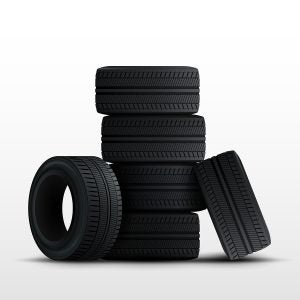
Buy 3 tires, Get the 4th for $1 at Passport Toyota

Buy 3 tires Get the 4th for $1 Offer Expires 12/31/2018 Customer pays all mount, balance, tax and disposal fees for all tires. CLICK HERE TO SCHEDULE SERVICE Toyota Vehicles Only. Must present when service order is written. One coupon per customer. May not be combined with other offers. Not applicable to prior purchases. Not responsible for typographical or printing errors. Other restrictions may apply.

Watch as the Pre-Collision System featured on the Toyota Tacoma Saves the Day

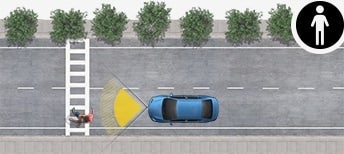
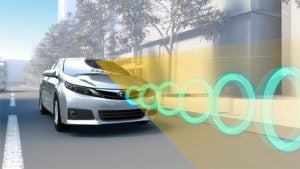
All 2019 Tacoma’s come with Pre-Collision System because play should never be interrupted. Pre-Collision System With Pedestrian Detection Using an in-vehicle camera and a radar sensor or a laser sensor that are designed to help detect a vehicle or a pedestrian in front of you, the Pre-Collision System with Pedestrian Detection (PCS w/PD) is designed to help you mitigate or avoid a potential collision. If the system determines that a frontal collision is likely, it prompts you to take action using audio and visual alerts. If you notice the potential collision and apply the brakes, PCS w/PD may apply additional force using Brake Assist (BA). If you don’t brake in time, it may automatically apply the brakes to reduce your speed, helping to minimize the likelihood of a frontal collision or reduce its severity. Available On: Avalon, Avalon Hybrid, Camry, Camry Hybrid, C-HR, Land Cruiser, Corolla, Highlander, Highlander Hybrid, Prius, Prius Prime, RAV4, RAV4 Hybrid, Tundra, Sequoia, Tacoma, Sienna, Yaris Liftback,* Prius c *Pedestrian Detection not available on Yaris Liftback. Bicyclist Detection During daylight conditions, the in-vehicle camera and a radar sensor or a laser sensor work together to help detect a bicyclist ahead and will prompt you to take action using audio and visual warnings if a collision is likely.

Get Up to $3,000 Cash Back during Toyotathon at Passport Toyota

Toyotathon is on! Purchase the 2018 Toyota RAV4 with 1.9% APR Financing for 72 months or get up to $3,000 Cash Back from Toyota Purchase the 2019 Toyota Camry with 0% APR Financing or get up to $1,000 Cash Back from Toyota

“Toyota Safety Sense” Preventive Safety Package-equipped Vehicles Top 10 Million Units Globally

Toyota Motor Corporation (Toyota) announces the total global number of vehicles equipped with Toyota Safety Sense (TSS)1, the Toyota-developed preventive safety package, has reached the 10 million unit mark, approximately three and a half years after its March 2015 introduction. It is anticipated that within this year, three million vehicles in Japan and five million vehicles in North America will have the package. Toyota first introduced the package with the “Corolla” series, centered on the belief that popularizing safety technology is vital. Toyota Safety Sense is currently equipped in approximately 90 percent of Toyota and Lexus vehicles2 for the Japanese, United States, and European markets. At present, it has been introduced in a total of 68 countries and regions, including China, other select Asian countries, the Middle East, and Australia. more Toyota Safety Sense helps avoid or mitigate damage and/or injury from serious traffic accidents, based on accident data from Japan, the United States, and Europe. It comprises the following three aspects: • Pre-Collision System (PCS): helps prevent and mitigate damage from rear-end collisions involving vehicles and/or pedestrians3 • Lane Departure Alert (LDA): helps prevent vehicles from deviating from their lanes and head-on collisions4 • Automatic High Beam (AHB): contributes to the early detection of pedestrians and the reduction of accidents during nighttime driving5 Rear-end collisions—the most common type of accident in Japan—involving vehicles equipped with Toyota Safety Sense have been reduced by approximately 70 percent6. If TSS and Intelligent Clearance Sonar (ICS), which covers lower-speed collisions, are combined, rear-end collisions have fallen by approximately 90 percent. Toyota Safety Sense is further evolving, based on a two-pronged approach of bolstering its adaptability to traffic accidents involving fatalities and/or injuries, and further popularizing the package, aiming toward the goal of completely eliminating traffic fatalities and injuries. The second-generation Toyota Safety Sense, introduced in January 2018, makes improvements in detection and performance compared to the previous version, and allows the package to respond to nighttime pedestrian and/or bicycle accidents. Further development is focusing on expanding adaptability to traffic accidents involving fatalities and/or injuries, such as with pedestrians and head-on collisions with oncoming traffic at intersections. Toyota and Lexus aim to introduce the packages in around 100 countries and regions, including Asia and Latin America, by 2020. With a focus on providing everyone with safe, reliable mobility, Toyota considers Safety Sense a cornerstone of safe car-making. Toyota will continue to develop safety from a wide range of perspectives, including activities to raise awareness such as “Support Toyota”7 and by supporting development of a traffic environment that includes the use of Intelligent Transport System (ITS) and connected technologies. click here to view full article.

Electrifying Design Meets Electrified Power in First-Ever Corolla Hybrid

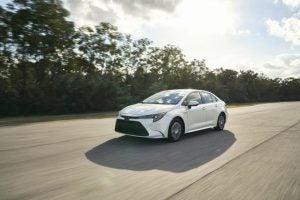
With its bumper-to-bumper, wheels-to-roof transformation, the 2020 Toyota Corolla was already big news in sedans for 2019. And now comes the ultimate “But wait, there’s more!” bonus: a new hybrid model that achieves at least 50 mpg combined fuel economy (projected). That makes the 2020 Corolla Hybrid the most fuel-efficient model to ever wear the model name that debuted more than a half-century ago. The design isn’t the only thing electrifying about the Corolla Hybrid. This high-efficiency model adapts the latest Toyota Hybrid Synergy Drive from the new-generation Prius, already proven as an MPG winner. Only Toyota offers such a distinct choice of hybrids in this vehicle segment, thus catering to customers who have different tastes in design but the same desire for maximum fuel efficiency. The 2020 Corolla Hybrid, like its gas-powered siblings, delivers a highly-satisfying driving experience, along with the brand’s latest advances in comfort and multimedia technology. As on the 2020 Corolla gas models, the Toyota Safety Sense 2.0 suite of active safety systems comes standard. The 2020 Corolla Hybrid is yet more evidence of Toyota’s indisputable global hybrid leadership, which began more than 20 years ago. more Fit for a Hybrid The hybrid powertrain and battery were a natural fit for the new Corolla because of the Toyota New Global Architecture (TNGA) platform. There’s no compromise in cabin roominess, for example, when choosing the Corolla Hybrid versus a gas model. The new hybrid system combines a 1.8-liter four-cylinder gasoline engine with two motor/generators through an electronically controlled planetary-type continuously variable transmission (CVT) transaxle. Combined system output of 121 horsepower yields decidedly responsive performance. The nickel-metal hydride (Ni-MH) battery pack employs a newly developed technology called Hyper-Prime Nickel™ to boost battery performance in a smaller and lighter package. The battery’s smaller size and flatter shape allow it to be packaged under the rear seat, rather than taking up trunk space, and also allowing a 60/40 split folding rear seatback to expand cargo capacity. The battery location also contributes to the vehicle’s lower center of gravity, a boon to agility. The engine, working in concert with the electric motor (MG2), assures responsive performance, while exemplary energy efficiency is achieved by using both electric motors (MG1 and MG2) for hybrid battery charging. Driving the Corolla Hybrid The Corolla Hybrid’s linear acceleration response may take some by surprise. When pulling away, the battery provides a subtle power boost in order to put less strain on the engine and eliminate the “rubber band” effect experienced with some hybrids. A preload differential adds to the confident acceleration feel. During low loads and low differential rotation, differential-limited torque is distributed to the left and right wheels, yielding excellent handling stability. At mid-range and high engine loads, the preload differential functions as an open differential. Corolla Hybrid has EV mode, which allows the vehicle to be operated as a pure electric vehicle for short distances, depending upon certain conditions, such as battery charge level. This mode is useful for operating the vehicle in parking lots or indoor parking garages, for example. The Vehicle Proximity Notification feature alerts pedestrians of the vehicle’s presence when running in battery mode. Along with the expected NORMAL and ECO drive modes, a SPORT drive mode setting allows for an increase in power for stronger acceleration response when desired. NORMAL mode: Allows the hybrid system to achieve an ideal combination of fuel economy and vehicle acceleration. The accelerator opening amount changes linearly in response to accelerator pedal operation. ECO mode: Improves hybrid system efficiency by limiting power in response to light to moderate accelerator pedal input. SPORT mode: Available power is increased, allowing for improved acceleration response. Stopping the Corolla Hybrid Another boost to efficiency comes from the Electronically Controlled Brake (ECB) system, which coordinates operation between the regenerative braking force of the electric motors and the hydraulic braking system force to provide optimal stopping power. By proactively using the electric motors to recover as much electrical energy as possible from the regenerative braking system, this extremely efficient cooperative control helps to maximize fuel economy. An active hydraulic booster on the conventional (non-regenerative) braking system improves pedal feel and feedback for the driver. Critically, should there ever be a malfunction in the ECB system, the conventional hydraulic braking system can stop the vehicle. Brake Hold, when engaged, is a convenient technology that reduces driver effort while waiting at a traffic light or while driving in heavy traffic. When the driver presses the accelerator, Brake Hold releases instantly. How the Other Half Works The other half of the Hybrid Synergy Drive team, the gas engine, is no less impressive than the electric side. The 2ZR-FXE 1.8-liter inline four-cylinder engine was designed specifically for a hybrid application. The long-stroke configuration employs the Atkinson cycle, which uses a very high compression ratio (13.0:1) along with a shorter intake stroke and longer expansion stroke than the Otto cycle. The Atkinson cycle extracts more energy from the fuel, and the electric motors compensate for reduced low-end power (versus the Otto cycle). Friction created by the piston skirts, rotating parts and oil pump is reduced, and an electric water pump eliminates the parasitic losses with a conventional belt-driven pump. Toyota sought efficiency gains in every system. The highly-efficient air conditioning system, for example, uses S-FLOW control, which automatically optimizes airflow throughout the cabin according to the temperature setting, actual cabin and outside temperatures, sunlight intensity, and occupied seats. Getting the engine up to operating temperature quickly is critical to conserving fuel and reducing emissions at start-up. In the Corolla Hybrid, an exhaust heat recirculation system speeds up engine coolant warm-up. That in turn allows the hybrid system to stop the gas engine earlier and more often in the driving cycle when it’s not needed, for example in low-power-demand city driving conditions. The PTC (Positive Temperature Coefficient) heater quickly provides cabin heat electrically in cold temperatures. Hybrid Exclusives The Corolla Hybrid rolls on 15-inch aluminum alloy wheels with low-rolling resistance tires. As on the Corolla gas models, the new multi-link rear suspension improves both handling agility and ride comfort compared to the previous-generation Corolla Sedan. The instrument panel uses a high-grade meter with a 7-inch Multi-Information Display (MID). The MID shows the speedometer, as well as a hybrid system indicator/real-time battery charge status indicator. ECO accelerator guidance, also shown in the MID, can provide a guideline for maximizing fuel efficiency by coaching the driver on optimal accelerator pedal operation to match driving conditions. Drivers who like the visual appeal of seeing engine rpm can choose to display a tachometer. Multimedia Mogul The 2020 Corolla Hybrid’s multimedia offerings start with the standard Entune™ 3.0 Audio system that includes: 8-in. touchscreen display; six speakers; Apple CarPlay compatibility; Amazon Alexa; Entune 3.0 App Suite Connect; Safety Connect; Wi-Fi Connect; Scout GPS Link Compatible; Siri Eyes Free; auxiliary audio jack and USB 2.0 port with iPod connectivity and control; AM/FM; MP3/WMA playback capability; voice recognition training and tutorials; hands-free phone capability; voice recognition; music streaming via Bluetooth; customizable home screen, and weather/traffic information via Entune 3.0 App Suite. Safety The Corolla Hybrid features eight standard airbags and Toyota’s Star Safety System, which includes Enhanced Vehicle Stability Control, Traction Control, Electronic Brake-force Distribution, Brake Assist, Anti-lock Braking System, and Smart Stop Technology. All Corolla models come equipped with a standard backup camera. Toyota Safety Sense 2.0 Significantly, all 2020 Corolla models are equipped as standard with Toyota Safety Sense™ 2.0, an advanced suite of integrated active safety features. PCS (Pre-Collision System): Is designed to automatically activate the brakes to help avoid a collision or mitigate the impact force. PCS is able to detect a vehicle or pedestrian in day and low-light conditions, as well as a bicycle during daylight. Full-Speed DRCC (Dynamic Radar Cruise Control): Designed for highway use, designed to maintain a set vehicle-to-vehicle distance and is also capable of low-speed following up to speeds of about 24 mph. The Corolla can stop when the vehicle ahead comes to a stop, maintaining an appropriate distance to it. LDA (Lane Departure Alert) w/ Steer Assist: Designed to give the driver audible and visual warnings and, if necessary, provides steering assistance if it detects the possibility of leaving the driving lane. It also detects excess weaving within the driving lane that might indicate driver distraction, inattention or drowsiness. LTA (Lane Tracing Assist): LTA is enabled when LDA and DRCC are both on and active. LTA employs a lane centering function that will make constant steering inputs to help the driver keep the vehicle in its lane. LTA is designed for uses on relatively straight highways to preemptively avoid unwanted lane departures and reduce driver fatigue. AHB (Automatic High Beam): When enabled, detects the headlights of oncoming vehicles and taillights of preceding vehicles and automatically switches between high and low beams as appropriate. RSA (Road Sign Assist): Designed to recognize speed limit, Stop, Yield, and Do Not Enter signs and display them on the vehicles MID to help assist the driver.

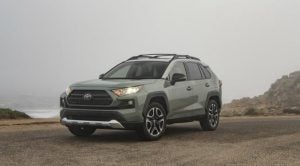
RAV4 Technology: Smartest SUV On the Block

From new multimedia technology to smarter all-wheel drive and a more efficient hybrid powertrain, the fifth-generation Toyota RAV4 is brimming with high-tech that works seamlessly and conveniently to deliver a rewarding driving and ownership experience. The technology show starts when you step into the RAV4. On Adventure, Limited and XSE grades, the 7-inch TFT speedometer can be switched between analog and digital displays, letting the driver set the mood. The Multi-Information Display (MID) is upgraded to 7.0-inches, versus 4.2-inches in lower grades. Through new multimedia technology, RAV4 connects with its driver’s lifestyle as never before. Every 2019 RAV4 model is equipped with Amazon Alexa and Google Assistant capability and Entune 3.0 Audio, a comprehensive system that includes 6 speakers, 7.0-in. touchscreen, AM/FM, Scout GPS Link Compatible with up to 3-year trial, Siri Eyes Free, Apple CarPlay Compatible, aux. port, USB media port (plus four additional USB charging ports on XLE and above), hands-free phone capability, advanced voice recognition and music streaming via Bluetooth. Toyota Connected Services include Safety Connect with 3-year trial and Wi-Fi Connect Powered by Verizon with up to 2GB within a 6-month trial. more The XLE grade can be upgraded with Entune 3.0 Audio Plus, which adds an 8-inch touchscreen and SiriusXM Radio, plus Toyota Connected Services/Service Connect with a complementary 3-year trial. Entune 3.0 Premium Audio with Dynamic Navigation is available for the Adventure and Limited grades, also using an 8-inch touchscreen, Dynamic Navigation with up to a 3-year complementary trial, Dynamic POI Search and Dynamic voice recognition. It can be packaged with the JBL with Clari-Fi audio system, which rocks music of all genres through 11 speakers in nine locations at 800 watts. This knockout audio system features: • A-pillar horn tweeters located for optimal high-frequency performance • Next-generation HiD8 Amplifier • Wide-dispersion instrument panel speakers providing greater sound and alert functionality • Wide-dispersion front door speakers enhancing sound quality for front passengers • Full range rear door speakers enhancing sound quality for rear passengers • Ported subwoofer in rear cargo area with a more powerful deep-bass response • Clari-Fi technology that intelligently adjusts to every audio format to match source quality with the precise level of audio restoration necessary Optional Technology Packages vary by grade, adding Intelligent Clearance Sonar with Rear Cross-Traffic Braking on the XLE, and then also expanding to the new Digital Rearview Mirror and Qi-compatible wireless smartphone charging on higher grades. For the Limited grade, which already has some of those features, the available Advanced Technology Package includes the Smart Key System on all doors and height-adjustable, foot-activated power liftgate with jam protection, Bird’s Eye View Camera with Perimeter Scan, Overhead 360-degree view in drive and reverse, and curb view, plus Qi-compatible wireless charging. Smarter All-Wheel Drive All-wheel drive (AWD) may have become a ubiquitous term in the automotive industry, especially among SUVs, but not all AWD systems are the same. Toyota took a smarter approach to a technology that many might not even think about. The result is additional effective traction for inclement and slippery weather and trails, while reducing AWD’s typical drag on fuel economy. The 2019 RAV4 offers three different AWD systems. In LE and XLE models, the optional AWD can send up to 50 percent of available torque to the rear wheels when necessary. Standard on AWD-equipped Limited gas and Adventure grade models, Dynamic Torque Vectoring is added to the AWD system, which uses special couplings to manage torque distribution between the left and right rear wheels. As a result, should one rear wheel lose contact with the surface – during trail driving, for example – torque will flow to the grounded wheel to help keep the vehicle moving. In driving situations where AWD is not needed, Rear Driveline Disconnect uses a ratchet-type dog clutch to disengage the rear wheels and stop the rear drive shaft’s rotation. That reduces the energy needed to propel the vehicle, therefore helping to reduce fuel consumption. Why Wait for Slip? The RAV4 AWD system does not simply react to wheel slippage. Rather, the sophisticated AWD Integrated Management (AIM) integrates control of the engine, transmission, Electric Power Steering (EPS), AWD system, and brakes, changing its logic according to the driving environment. During on-road driving, the system manages steering assist, throttle control, shift control and drive force distribution to further enhance steering stability. In off-road driving situations, the system adds brake control to the mix. Standard on AWD-equipped gas RAV4 models, Multi-Terrain Select gives drivers the ability to maximize traction when driving through mud, sand, rocks or dirt. The system is easy to use thanks to control buttons or a control dial (depending on the grade) positioned to the left of the transmission shift lever. The driver can select Mud & Sand mode for beach driving, or Rock & Dirt mode for trails. Using the Multi-Information Display (MID), the driver can view torque allocation and slip control, which will fluctuate depending on driving and road conditions. Toyota Safety Sense 2.0 Toyota has fulfilled a goal to make driver safety systems with automatic emergency braking standard on most models, and the 2019 RAV4 debuts with the second generation of the Toyota Safety Sense system (TSS 2.0). The full system is standard on all grades and includes: Pre-Collision System with Pedestrian Detection (PCS w/PD) Capability to detect a preceding vehicle or pedestrian in daytime or with better low-light recognition capabilities, or daytime bicyclist (new). System will alert the driver with audible and visual warnings and/or apply brakes to help mitigate or avoid the collision in certain cases (using Forward Collision Warning (FCW), Brake Assist (BA), and Automatic Emergency Braking (AEB). Full-Speed Range Dynamic Radar Cruise Control (DRCC) For highways/freeways only, this adaptive cruise control functions at 0-110 mph and enables low-speed speed matching, stopping, and acceleration/deceleration relative to a preceding vehicle traveling at a slower speed. Speed, cut-in, and distance control are enhanced, as well as Turn Signal Linked control added, for a more natural response. Lane Departure Alert with Steering Assist (LDA w/SA) Newly added to LDA w/SA is the capability, under some circumstances, to detect the road’s edge, in addition to the pre-existing capability to detect visible lane markers and the vehicle’s position in the lane. If unintentional lane deviation is detected, the system alerts the driver with audible and visual warnings. Steering Assist can provide small corrective steering inputs to help the driver prevent the vehicle from unintentionally leaving its lane. Automatic High Beam (AHB) Capability to automatically activate and deactivate high beams based on the driving environment and preceding vehicle’s lights. New Lane Tracing Assist (LTA) For highways/freeways only, LTA can be enabled when using DRCC and has the capability to recognize white or yellow lane markings or the path of a preceding vehicle if lane markers are temporarily unavailable. It can also identify and actively track the center of the lane by providing steering assistance (hands-on, driver-assist system). This reduces driver burden and helps support safe driving, especially in traffic congestion on long highway trips. The LTA system can be turned on/off. New Road Sign Assist (RSA) Capability to identify certain Stop, Yield, Do Not Enter and speed limit signs and signal driver with visual and audible alerts. The alerts vary based on sign type and are shown on the Multi-Information Display (MID). Smarter Hybrid Since introducing the first mass-production gas/electric hybrid vehicle, the Prius, 22 years ago, Toyota has continually refined and upgraded the technology. The new-generation Toyota Hybrid system in the RAV4 HV is more compact, more efficient and quieter than in the previous model. Big changes in the geartrain yield significant efficiency improvements. The new transaxle mounts the electric motors (MG1 and MG2) coaxially rather than in-line, and the resulting smaller and lighter package reduces frictional losses. The reduction gear is now a parallel shaft gear, rather than a planetary, and a new multi-function gear integrates the power-split planetary ring gear, parking gear, and counter-drive gear. The changes add up to an approximately 25-percent reduction in transmission losses compared to the previous model. ? Further efficiency improvements come from a variable cooling system (electric water pump, electric thermostat) and a fully variable oil pump. Energy transmission losses are reduced by new computer integration and a smaller, lighter power stack installed directly above the transaxle. The new Ni-MH battery pack is smaller and more efficient than in the previous RAV4 HV, reducing HV battery charging time and frequency and contributing to enhanced fuel efficiency. The pack is small enough to be installed under the rear seats, rather than taking up space under the cargo area. Hybrids Have Fun, Too. The RAV4 HV driver will notice a more linear acceleration feel, thanks to the way the system optimizes the level of electric motor assistance and engine rpm without the engine running at high revs. Engine speed is synchronized with vehicle speed. Differential pre-load yields better standing-start performance and straight-line stability. Sport mode optimizes drive torque to prioritize acceleration performance, making RAV4 HV feel more responsive. A sequential shifting feature delivers responsive engine braking force in steps, like a manual transmission. The driver can “downshift” the vehicle for more engine braking using auto-manual shifting or the “S” position on the shift lever. The 2019 RAV4 HV can even coach the driver toward achieving higher fuel economy. An accelerator guide function suggests an acceleration amount to the driver according to the driving conditions, and a scoring function adds a measure of fun to eco driving. Predictive Efficient Drive What if a vehicle could teach itself to operate more efficiently? That’s the concept behind the RAV4 HV’s Predictive Efficient Drive. With navigation system operation, it analyzes driving habits and the expected road and traffic conditions to optimize hybrid battery charging and discharging. The more the RAV4 Hybrid is driven, the more data is gathered to help optimize fuel consumption. (The system can be turned off.) Predictive Deceleration Support technology uses accumulated knowledge about a driver’s behavior to predict when and where the vehicle is likely to slow down or stop, reducing energy consumption through optimum accelerator pedal release timing guidance. The system can predict deceleration behavior up to approximately two-tenths of a mile ahead of the target zone. ? Predictive State of Charge (SOC) predicts if there are any downhill roads or traffic jams ahead while the navigation system is providing route guidance, contributing to improved actual fuel efficiency by increasing the hybrid battery charging when appropriate. For example, it could draw more from the battery before a downhill section, thereby maximizing the benefit of regeneration on the downhill section. If traffic congestion is shown to be ahead, the system will actively charge the battery beforehand, so that the vehicle can rely more on battery power when it reaches that congestion.


It's the best Thursday of the year! Happy Thanksgiving from Passport Toyota

Wishing that your Thanksgiving is full of love, warmth, and extra special moments. Have a Happy Thanksgiving!

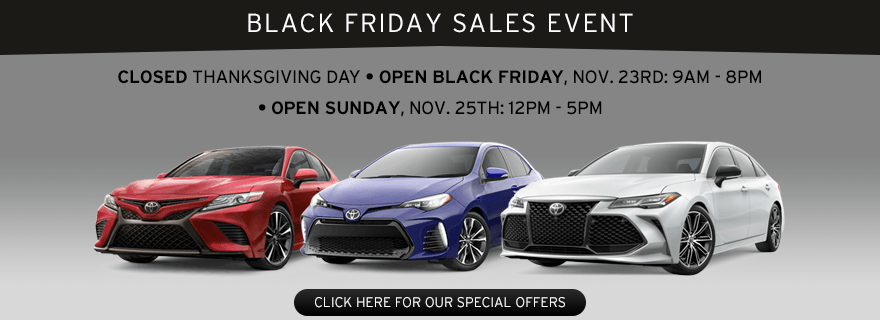
Don't Miss the Black Friday Sale going on at Passport Toyota

Closed Thanksgiving Open Friday: 9AM-8PM Open Sunday: 12PM-5PM Click here to view our special offers

Contact Us

Fill out this form below and we'll contact you shortly
*Required Fields