
Blog / New Vehicles

Toyota to Reduce Emissions from North American Operations by up to Forty Percent
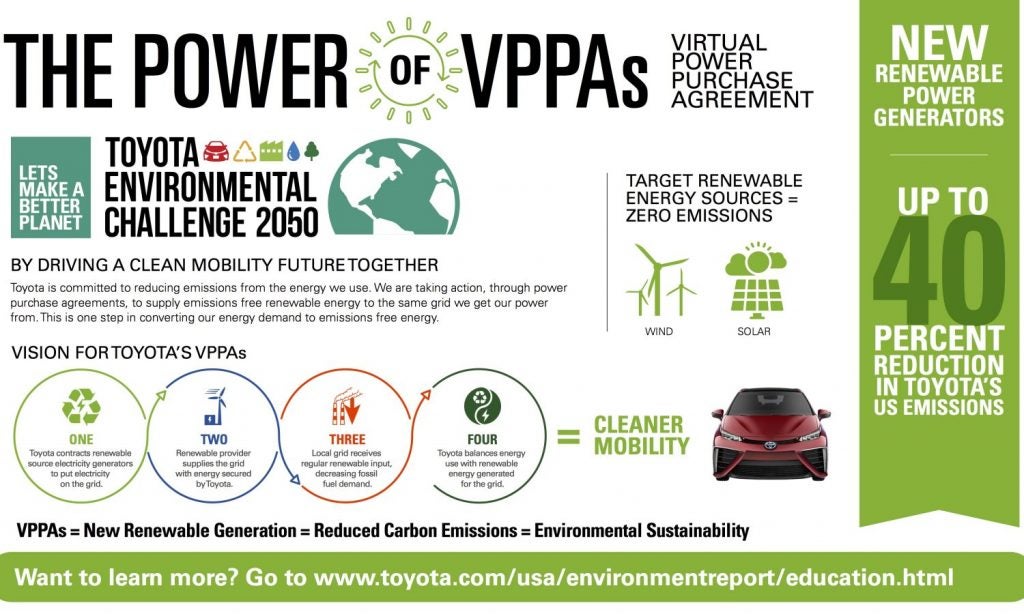
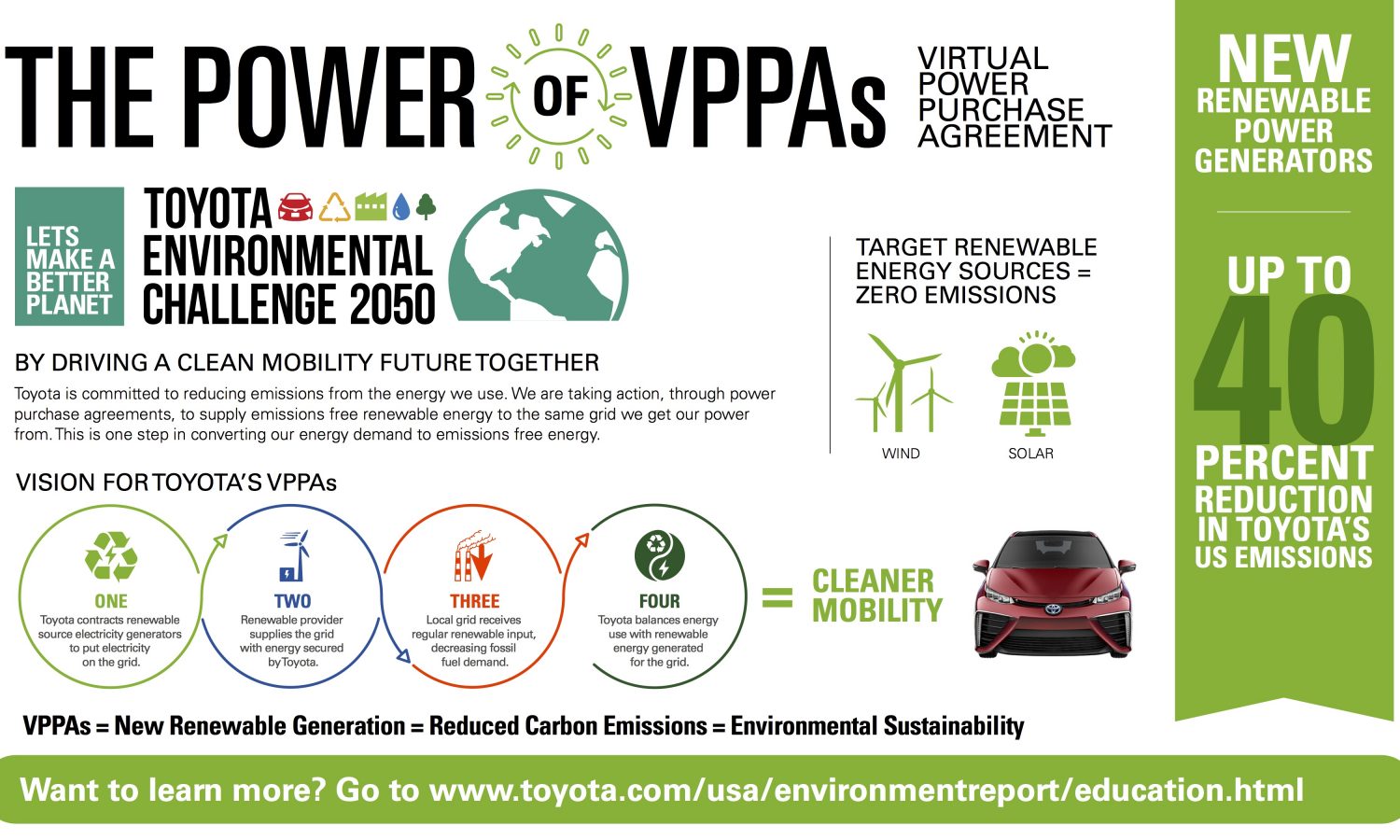
Toyota Motor North America (TMNA) is committing to aggressively reduce its carbon output in the United States by entering into Virtual Power Purchase Agreements (VPPAs). It will use them to reduce emissions from its North American operations by up to forty percent over the next 3 years. The move represents another major step towards Toyota’s Environmental Challenge 2050 goal of cutting global emissions from plant operations to zero globally by the year 2050. Under the VPPAs, which the company expects to commence later this year, TMNA will contract with renewable energy providers to generate wind and solar power that will be provided directly to regional electric grids. The supply of renewable power is expected to reduce use of fossil fuels while improving the sustainability of the electric grid in the area. By powering its operations from the enhanced grid and applying Renewable Energy Credits earned by funding the generation of renewable electricity, Toyota expects to substantially offset emissions from its facilities in North America. “Toyota has long been defined by its commitment to responsible environmental practices, and we’re proud to build upon that great legacy today,” said Kevin Butt, General Manager and Regional Environmental Sustainability Director for Toyota Motor North America. “We are committed to setting an example of sustainability that goes beyond vehicles to show how a company can significantly reduce the environmental impact of its operations. By cutting our U.S. emissions by forty percent, we will be that much closer to our goal of having a net positive impact on the environment by the middle of this century.” Toyota’s VPPA program is the result of more than six years of research into how best to reduce and offset emissions from the company’s operations, working in partnership with MIT, the National Renewable Energy Lab, the Rocky Mountain Institute, and others. It is part of a wider effort across the company to reduce the environmental impact of enterprise operations as it also works to limit vehicle emissions. This endeavor supports Toyota’s Environmental Challenge 2050. Launched in 2015, the Challenge sets out six objectives for the company’s global operations, including: 1. A ninety percent reduction in global average CO2 emissions from new vehicles vs. 2010 levels; 2. The complete elimination of CO2 emissions from the entire vehicle life cycle; zero emissions at all manufacturing plants worldwide; 3. Elimination of CO2 emissions from all suppliers and logistics streams from overall operations; 4. Minimizing water usage and implementing water discharge management protocols; 5. Promoting global deployment of end-of-life vehicle treatment and recycling, and; 6. Connecting and promoting nature conservation activities outside of the Toyota Group in the communities where we operate.
Posted in:

Related Posts

First-Ever Toyota Avalon XSE Hybrid Nightshade Edition Highlights Changes for 2022

The 2022 Avalon is Toyota’s take on full-size refinement and style. With striking, coupe-inspired design, a spacious, luxury interior, and Toyota Safety Sense 2.5+ (TSS-2.5+) standard on all grades, the 2022 Avalon offers drivers the comfort, quality, and safety they expect from a premium sedan. This year, the XSE Hybrid Nightshade Edition joins the Avalon family. For 2022, Avalon features six configurations across its Hybrid and V6 powertrains. Configurations include XLE, Limited, Touring, XLE Hybrid, XSE Hybrid Nightshade, and Limited Hybrid. With a choice of a silken yet spirited 301-horsepower V6 or a hybrid electric powertrain that achieves an EPA estimated 44 miles per gallon (XLE Hybrid grade), drivers can choose the powertrain that fits their needs. Since the model was launched in 1994, the Toyota Avalon has brought a balance of luxury and safety. For 2022, the entire Avalon lineup moves to TSS 2.5+, which adds Road Sign Assist and Lane Tracing Assist to the active safety system. The Limited, Limited Hybrid and Touring models offer an Advanced Safety Package that includes Bird’s Eye View Camera with Perimeter Scan and Intelligent Clearance Sonar with Rear Cross-Traffic Braking. Toyota’s Rear Seat Reminder is now standard on all 2022 Avalons. The feature notes whether a rear door was opened within 10 minutes of the vehicle being turned on, or at any time after the vehicle has been turned on, with a reminder message in the instrument cluster after the engine is turned off, accompanied by multitone chimes. Click here to read the full article.

Get top dollar for your vehicle at Passport Toyota

We want to buy your vehicle! Get top dollar for your vehicle. All makes and models are needed. Click Here To Get A Real-Time Offer For Your Car In Seconds Get Your Offer Give us a few vehicle details and we’ll send you a real, cash offer in a second Bring It To Us Bring in your offer and your vehicle. After a quick, on-site review of the vehicle, we’ll cut you a check. Get Paid or Upgrade If you’re looking to upgrade you can use your cash offer to trade for a new ride. Your choice - cash or keys to a new car!

Toyota Mirai Sets GUINNESS WORLD RECORDS™ Title with 845 Mile Zero Emission Journey

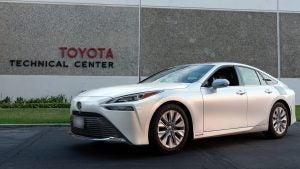
The 2021 Toyota Mirai has officially set the GUINNESS WORLD RECORDS title for the longest distance by a hydrogen fuel cell electric vehicle without refueling. The Mirai achieved an unprecedented 845 miles driven on a single, five-minute complete fill of hydrogen during a roundtrip tour of Southern California as it set the record. Recently selected by Ward’s Automotive as a 10Best Engine & Propulsion Systems winner, the Toyota Mirai’s record sets a new distance milestone for zero emission vehicles. “In 2016, the Toyota Mirai was the first production fuel cell electric vehicle available for retail sale in North America, and now the next generation Mirai is setting distance records,” said Bob Carter, executive vice president, Toyota Motor North America. “We are proud to be leaders of this exciting technology, which is just one of a growing lineup of zero emission vehicles in our portfolio.” more The official record attempt was closely monitored by Guinness World Records, adhering to its strict rules and documentation procedures. On its efficiency-focused August 23 and 24, 2021 journey, the Mirai logged an impressive 152 MPGe with water as its only emission. GUINNESS WORLD RECORDS adjudicator, Michael Empric, validated the Mirai’s tank with a seal at both the beginning and end of the journey. Driven by professional hypermiler, Wayne Gerdes and co-piloted by Bob Winger, the two-day trip began on Monday, August 23, 2021, at the Toyota Technical Center (TTC) in Gardena, California, home of Toyota’s fuel cell development group. The duo traveled south to San Ysidro and then north to Santa Barbara cruising through Santa Monica and Malibu beach along the Pacific Coast Highway. They returned to TTC that evening and logged 473 miles with only two driver swaps that day. The next day, August 24, 2021, consisted of more local driving loops, where they pushed through 372 more miles of morning and afternoon rush hour traffic on the San Diego freeway between Los Angeles and Orange County until the Mirai had no more hydrogen left and coasted into TTC with a grand total of 845 miles driven, as witnessed by Empric. “As a GUINNESS WORLD RECORDS adjudicator for 10 years, I’ve had the opportunity to witness incredible attempts, including several distance-related feats,” said Empric. “The Toyota Mirai’s journey without the need to refuel showcases the power of fuel cell electric technology. This technology and the design ingenuity by the team at Toyota led to a history-making moment.” By the end of the trip, the Mirai consumed a total of 5.65kg of hydrogen and passed a total of 12 hydrogen stations along the drive routes without refueling. The Mirai was driven mainly during rush hour traffic in temperatures between 65 to 83 degrees Fahrenheit. It emitted zero pounds of CO2, where a standard internal combustion engine vehicle would have emitted about 664 lbs. of CO2 over the same distance. The landmark results were achieved by drivers skilled in hypermiling techniques that optimized the Mirai’s vehicle performance under specific weather and driving conditions. They also leveraged some basic fuel-efficient driving tips that any driver can practice. MAINTENANCE & PREPARATION: • Keep up on all scheduled maintenance. A poorly tuned engine will burn more fuel, which can impact fuel economy. (FUN FACT: The 2021 Mirai comes with extended ToyotaCare coverage – a scheduled maintenance plan for 3 years or 35,000 miles!) • Ensure proper wheel alignment. • Check tire pressure, under-inflated tires can lower fuel economy. • Remove cargo or cargo racks to reduce weight. DRIVING TECHNIQUES: • Avoid quick acceleration or heavy braking. • Avoid driving at higher speeds. • Minimize running mechanical and electrical accessories i.e. air conditioner. (FUN FACT: The 2021 Mirai has Drive Mode Select, which offers an ECO mode to prioritize efficiency by optimizing air conditioning operation. Additionally, as on Toyota Hybrids, Predictive Efficient Drive can learn repeatedly traveled routes to optimize charging and discharging of the battery to help maximize fuel economy and driving range.)