
Blog / Passport Toyota News

Toyota Doubles-Down on Zero Emissions Heavy-duty Trucks
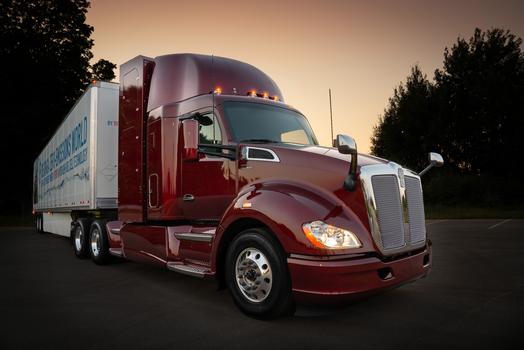
Toyota took the next great leap towards the future of zero-emission trucking, unveiling the second iteration of its hydrogen fuel cell electric Class 8 truck before a crowd of media and industry leaders during the Center for Automotive Research (CAR) Management Briefing Seminars in Northern Michigan. The new truck, known internally as "Beta," expands on the capabilities of Toyota’s first Project Portal test vehicle by increasing the estimated range to more than 300 miles per fill. The truck also enhances versatility and maneuverability with the addition of a sleeper cab and a unique fuel cabinet combination that further increases cab space without increasing wheelbase. Since it first began operation in April 2017, the Project Portal “Alpha” truck has logged nearly 10,000 miles of testing and real-world drayage operations in and around the Ports of Long Beach and Los Angeles while emitting nothing but water vapor. The Beta vehicle will begin drayage operations in the fall, increasing the Ports’ zero emission trucking capacity and further reducing the environmental impact of drayage operations.Lessons Learned: Increased Range, Improved Process Project Portal 2.0 builds on the lessons learned from the launch of the Alpha vehicle in 2017. The first heavy-duty truck was the result of a true skunkworks effort within Toyota that moved from initial concept to a fully-capable drayage truck driving silently out of a Michigan garage in just over a year. Engineers and technicians worked long hours to reconfigure the wire harnesses, electronics and other components of two off-the-lot Mirai fuel cell electric cars to create one of the world’s first OEM-built zero-emission heavy trucks. The results of their work continue to impress. With a gross combined weight capacity of 80,000 lbs. and a driving range of more than 200 miles per fill, the 670-plus horsepower Alpha truck produces 1325 pound-feet of torque from two Mirai fuel cell stacks and a 12kWh battery. Project Portal Beta maintains these torque and horsepower numbers while also extending the range of the vehicle and pushing forward on other key performance metrics. “By evaluating the first truck in our test facilities and on the actual roads in the LA area, we made a list of improvements for the Beta truck build process and performance enhancements," said Andrew Lund, chief engineer for the project. He continued, "We needed to move beyond a proof of concept, which the first truck accomplished, to something that is not only better than the original but is also more commercially viable." A Step Toward the Future, Reflections From the Past The story of Project Portal’s inception and evolution follows the long tradition of Toyota innovation that dates to the company’s entry into the automotive space. The first Toyota (then Toyoda) sedan, the A1, was produced in much the same manner as the original Project Portal truck- through experimentation, trial and error, and a lot of sweat. Once completed in 1935, the A1 was tested by the company's founder, Kiichiro Toyoda, and then refined into their first commercially available car, the Toyoda AA. Likewise, through the lessons learned with the first truck, Project Portal 2.0 is more refined, functional, and capable. Also, just as the AA started Toyota on a path as an automotive leader, Project Portal is expanding Toyota's already robust environmental leadership to the next level. Going forward, Toyota remains committed to supporting the development of a consumer-facing hydrogen infrastructure to realize the potential of fuel cell vehicles. A Drop of h2 in the Bucket Over 16,000 pollution-emitting trucks are working in Ports of Long Beach and Los Angeles, a number that is estimated to balloon to 32,000 by 2030. More than 43,000 drayage trucks are in operation at ports across the United States, contributing significant amounts of carcinogens, diesel particulate matter (DPM) and other pollutants into the air of port communities and surrounding neighborhoods. “Our goal with the first truck was to see if it could be accomplished, and we did that,” said senior manager for Toyota’s North American Electrified Vehicle & Technologies Office, Craig Scott. “This time we're looking at commercial viability. We want to help make a difference—a significant difference when it comes to the air quality not only in the LA area, but across the U.S. and around the globe." More Than Just Trucks This announcement is a continuation of Toyota’s Environmental Challenge 2050 efforts to eliminate CO2 emissions from its Toyota Logistics facility at the Port of Long Beach. Toyota has previously announced the construction of the Tri-Gen facility which will be the first megawatt-sized carbonate fuel cell power generation plant with hydrogen fueling in the world. The 100% renewable plant will use agricultural waste to generate water, electricity, and hydrogen that will support Toyota Logistics Services' (TLS) operations at the Port of Long Beach.
Posted in:

Related Posts

Toyota returns to the Big Game with a 60-second ad that shares an inspiring message of determination and spotlights the power of sport

Toyota’s Big Game ad – “Brothers” – features two real-life brothers: Brian McKeever (Global Team Toyota Athlete and Canada’s most decorated Winter Paralympian) and Robin McKeever (Olympian, cross-country skiing / Paralympic guide and coach, Para Nordic Skiing). “Brothers” takes viewers on a journey of the brothers’ lives, from their childhood in Canada, where they develop a passion for cross-country skiing, to navigating the loss of Brian’s central vision at age 19 due to Stargardt Macular Degeneration. Despite living with the untreatable degenerative eye condition, Brian and his brother Robin continue to train together, which eventually leads Robin to compete at the Olympic Winter Games, and both brothers to compete at the Paralympic Winter Games with Robin serving as Brian’s guide. “Robin and Brian’s story reminds us that with strength, determination and the freedom to move, you can accomplish anything,” said Lisa Materazzo, group vice president, Toyota Marketing, Toyota Motor North America. “Toyota’s support of the Olympic and Paralympic Movement gives us the honor of highlighting our amazing Team Toyota athletes that achieve the impossible every day.” The 60-second spot begins with Robin teaching Brian how to ski at a young age. The brothers (portrayed by actors) are then shown admiring a cross-country skiing race on television, transitioning to adolescent Brian trying to keep up with Robin while bike riding down a neighborhood hill. The camera then cuts to a close-up x-ray of Brian’s eye, depicting the moment he learned of his Stargardt diagnosis. The spot continues with Robin encouraging his brother forward, vocally guiding him, with snippets interwoven depicting the moments of their training sessions. The spot concludes with a scene of the actual McKeever brothers crossing the finish line and winning Paralympic gold with the uplifting message: “After Brian lost his eyesight, the McKeever brothers went on to win 10 Paralympic medals. Together.” “I hope my story inspires viewers to start their impossible – whatever that might be,” said Brian McKeever. “I’ve learned firsthand that anything is possible with perseverance, and the support of a brother, like Robin.” “Brothers” will air in the first position (A) in the first commercial break of the Big Game on February 13, 2022 on NBC. “Brothers” was created by Toyota’s agency of record, Saatchi & Saatchi, in partnership with Dentsu and directed by Seb Edwards.

Here's to the road ahead. Happy New Year from Passport Toyota

We are grateful for our work with you in 2021, and we look forward to working together in the New Year. Happy 2022! We are open! New Year's Eve Hours: Sales Only 9 AM -6 PM New Year's Day Hours: Sales Only 12 PM- 5 PM Open Sunday, January 2nd Sales Only 12 PM - 5 PM

Dress up in a Toyota for Halloween during the Passport Toyota Monster Pre-Owned Sales Event

It stands to reason that the better a product is made the longer it will last, which makes getting a high-quality, low mileage Toyota at a great price a very savvy move. Toyota's timeless commitment to quality, innovation and durability is the foundation upon which the Toyota Certified Used Vehicles (TCUV) program launched in 1996. With each passing year the TCUV program has gained momentum - totaling over three million sales and counting. Along with industry-leading heritage comes another advantage; an exceptional coverage policy. With a 12-month/12,000-mile Limited Comprehensive Warranty1 a 7-year/100,000-mile Limited Powertrain Warranty2 plus one full year of Roadside Assistance3, honored at more than 1,400 Toyota dealers in the U.S. and Canada, we've got you covered. • 1.99% APR financing available ** on all eligible Toyota Certified Used Corolla Hatchback model. • 1.99% APR financing available ** on all eligible Toyota Certified Used Rav4 model. • 1.99% APR financing available ** on all eligible Toyota Certified Used Rav4 Hybrid model. • 1.99% APR financing available ** on all eligible Toyota Certified Used Corolla model. • 1.99% APR financing available ** on all eligible Toyota Certified Used Prius Prime model. • 1.99% APR financing available ** on all eligible Toyota Certified Used Prius Plugin model. • 1.99% APR financing available ** on all eligible Toyota Certified Used Prius v model. • 1.99% APR financing available ** on all eligible Toyota Certified Used iM model. • 1.99% APR financing available ** on all eligible Toyota Certified Used Camry Hybrid model. Click here to browse our Pre-Owned inventory. APR available with limited term to maturity and on approved credit, through participating dealers and Toyota Financial Services for only very well-qualified credit customers. Dealer contribution may vary and could affect price. Individual dealer prices, other terms and offers may vary. Must take retail delivery from participating dealer’s stock and terms subject to vehicle availability. See your participating dealer for details. Offer valid 09-01-2021 through 11-01-2021.