

Toyota C-HR Gets Tech+Styling Upgrades and a New Grade Strategy for 2019
Stylish, athletic and filled with technology like Toyota Safety Sense P™ (TSS-P), the 2019 Toyota C-HR is the Coupe High-Rider, still representing a leap forward in design, manufacturing and engineering for Toyota. Across all grades, new tech features are included for 2019, as all C-HR grades receive an 8-inch touchscreen with Apple CarPlay® connectivity as standard.
New Grade Strategy for 2019
Now available with a new grade strategy for 2019, the C-HR is available in three grades: LE, XLE and Limited (removing XLE Premium grade from 2018.) LE is equipped with 17-inch steel wheels and LED DRLs with halogen headlamps as well as a polyurethane steering wheel. For the XLE grade, standard features now include Blind Spot Monitor + Rear Cross Traffic Alert, auto-folding side mirrors, “Toyota C-HR” puddle lamps, piano black upper console and switch base, Smart Key with push button start, and available features now include Entune 3.0 Audio Plus. For the Limited grade, standard features now include fog lamps, piano black B-pillar, “Limited” badging, rain-sensing wipers, Entune 3.0 Audio Plus, heated front seats, driver seat power lumbar, chrome window trim and leather-trimmed or leather-trimmed/fabric seats. New options for the Limited grade now include Entune 3.0 Premium Audio.
A Distinctive Design
The iconic gemstone of the Toyota C-HR evokes universal notions of luxury, attractiveness, sophistication, and strength. At the C-HR’s nose, two slim projector-beam halogen headlights with LED daytime running lights (DRL) and auto-on/off activation wrap deep into its toned shoulders – nearly all the way into the front quarter panels. Because of this, the vehicle possesses an assertive fascia that’s uncommon in the segment. In fact, its dimensions – width (70.7 in.), height (61.6 in), length (171.2 in.), and wheelbase (103.9 in.) – can best be described as compact and neat. Its rear tracks match that of Toyota’s diehard sports car, 86, at 60.6 inches.
Deep, curvy character lines emerge from a prominent Toyota badge that’s flanked by the headlamps and lead into the narrower core body. They run below the windows and continue above the rear wheel where they marry to a high beltline and distinctive C-pillar with hidden-type design door handles.
The rear is a cohesive balance of its elaborate lines and 3D shapes. The tail lamps protrude outward and the hatchback –outfitted with a lip spoiler and functional color-matched cantilevered wing– tapers neatly inboard.
Toyota’s aerodynamicists pulled no punches when honing the C-HR’s 0.34 coefficient of drag. Canards on the rear quarter panels, front and rear spats, a streamlined rear lower bumper, and stabilizing fins integrated into the taillights all manage critical airflow in and around the body. Underneath, a bevy of rigid covers – on the engine, floor, fuel tank, and aft of the rear wheels – cull turbulence and, in doing so, help enhance vehicle control and fuel efficiency. At the rear, its aerodynamic details continue: the lower arms of the multi-link rear suspension have a streamlined edge.
As one can imagine, the exterior color options are plentiful for C-HR. Standard color options include Blue Eclipse Metallic, Magnetic Gray Metallic, Black Sand Pearl, Silver Knockout Metallic, and all-new-for-Toyota, Blue Flame (Radiant Green Mica discontinued.) Available colors include Ruby Flare Pearl and Blizzard Pearl.
For a bigger dose of individuality, the C-HR can be outfitted in R-Code, a special paintjob that pairs body color with either a black or white-painted roof (white R-code roof option only comes with Blue Eclipse Metallic), side mirrors and A-pillar for a truly custom look. Additionally, for 2019, the R-code black roof is now available with Silver Knockout Metallic, Blizzard Pearl, Ruby Flare Pearl, and Blue Flame.
Compact Punch
The C-HR’s engine, a 2.0-liter four-cylinder dual-overhead cam producing 144 horsepower at 6,100 rpm and 139 pound-feet of torque at 3,900 rpm, sends all power to the front wheels via the Continuously Variable Transmission with intelligence and Shift mode (CVTi-S). The engine employs many of Toyota’s latest generation of technologies, including Variable Valve Timing (VVT) and Valvematic, both of which have received extensive optimization to enhance fuel economy and smooth operation. Valvematic offers a broader range of continuously variable valve timing (lift and phasing) to provide optimal intake valve (not on exhaust side) operation relative to engine demands. Furthermore, to reduce exhaust emissions, the catalyst is warmed earlier during the engine’s ignition cycle. Both models have EPA-estimates of 27/city, 31/highway and 29/combined miles-per-gallon.
The CVTi-S received much attention by engineers and utilizes redesigned pulleys to enhance acceleration and fuel economy; a new belt structure to reduce cabin noise; and a coaxial two-port oil pump system that allows for continuous oil pressure modifications in various driving conditions. A Preload Differential helps to distribute torque between the left and right wheels during low-speed operation to make for easier, composed driving.
Of course, drivers and passengers will welcome the powertrain’s well-sorted nature, but they’ll love Sport mode and the simulated 7-speed Sequential Shiftmatic. Engaging Sport mode via the multi-information display (MID) increases the responsiveness of the throttle, quickens the CVT’s automatic artificial “step-up” shifts, and maintains high engine speed to enhance acceleration. The electronic power steering (EPS) systems’ feedback is weightier for a more confidence-inspiring feel. Pushing the gearshift over to the left while in Drive engages Sequential Shiftmatic, and lets drivers shift simulated gears at their convenience.
“MeZONE”-Designed Cabin
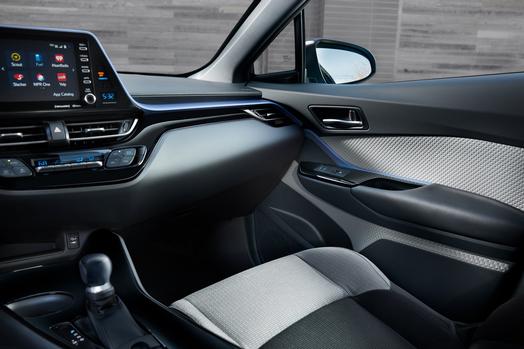
The C-HR offers a modern and uncluttered interior with a keen placement of accents and a driver-centric “MeZONE” orientation. Along with the soft-touch materials covering surfaces throughout, the diamond pattern influences the designs of the dual-zone climate controls, speaker surrounds and black headliner above the front passengers. Updates for 2019 include an available gray fabric for XLE grade and a black leather or brown leather/fabric combination for the Limited grade.
Together with slim A-pillars, the angled dashboard and amenity controls allow for the driver to have a clear view of the road ahead and intuitive access to instrumentation. The 8-inch audio display is positioned centrally atop the dash, rather than in it, to help reduce drivers’ eye movements. An informative twin-ring gauge cluster resides behind the leather-wrapped multi-function steering wheel. The tilt/telescoping wheel is reminiscent of a sports car’s easy-to-grip helm. The satin-plated shift knob exudes a high-quality feeling, and once in-hand, has a solid shift movement. A bright 4.2-inch color Multi-Information Display (MID) sits between the twin-ring cluster and shows odometer, SPORT and ECO modes, outside temperature, fuel economy and trip information, fuel economy history, G-force monitor, and much more.
Key LE standard features include all-black appointments; Remote Keyless Entry System, urethane tilt/telescopic steering wheel with audio, Multi-Information Display, Bluetooth® hands-free phone, voice-command, Full-Speed Range Dynamic Radar Cruise Control (DRCC), Lane Departure Alert (LDA) with steering assist and trip controls; Pre-Collision System with Pedestrian Detection and Automatic High Beams; leather-trimmed shift lever with satin-plated shift knob; Sport fabric-trimmed front bucket seats; 6-way adjustable driver's seat with sport bolsters; 6-way adjustable front passenger seat with sport bolsters; 3-passenger rear seating with fabric-trimmed 60/40 split fold-flat second-row rear seat with adjustable headrests and center armrest with 12V power outlet.
XLE and Limited Grades add a leather-trimmed tilt/telescopic steering wheel; Blind Spot Monitor and Rear Cross Traffic Alert and Smart Key System with Push Button Start. All models are equipped with a six-speaker AM/FM/HD Radio™, Aha™ app, USB 2.0 port with iPod® connectivity and control, Apple CarPlay® connectivity; AUX audio jack, Bluetooth® wireless connectivity, and Voice Recognition with voice training.
The C-HR offers a convenience feature called Brake Hold Function. This feature is designed to maintain braking force on all four wheels to keep the vehicle stationary when at a full stop. As a result, the vehicle will remain still even if the driver reduces the pressure on the brake pedal. Once the driver depresses the accelerator, brake pressure will release, and the vehicle will move forward.
Bolstered bucket seats help to keep passengers snug and comfortable. All passengers will appreciate the generous amount of small item storage space (sculpted in-door pockets) and cup holders (two front cup holders; two front, two rear bottle holders). Designers used scalloped seatbacks, foot well cubbies carved below the front seats, and a chamfered headliner to create a spacious backseat environment. Sound insulating materials placed on the carpet, headliner, A-pillars, and door trim help to keep unwanted noises out and the good chats in.
For extra cargo carrying versatility, the rear 60/40 seat can split and fold flat, and, when in an upright position, can easily accommodate child seats with its LATCH (Lower Anchors and Tethers for CHildren) system. Seatback lock releases are positioned at shoulder height, making it possible to fold seats without bending over. The rear seats are designed so that seatbelts do not interfere when folding the seats. As an added bonus in the cargo area is a hidden storage compartment located in the sidewall to store small items, as well as compartments below the deck board. Everything in the trunk is concealed by a standard cargo cover.
Impressive Ride Comfort
The Toyota C-HR scores high on style points, but it is also a hit when it comes to thrilling fun and impressive ride comfort. The C-HR’s adaptable Toyota New Global Architecture (TNGA) C-platform allows for on-road nimbleness and ride quality. The TNGA C-platform – with an inherent low center-of-gravity, high strength, and low weight – benefits from extra rigidity through added spot welding, gussets, braces, and adhesives in and on key connection structures.
The MacPherson strut front suspension has angled strut bearings and a large diameter stabilizer bar to help the C-HR’s front end respond quickly and precisely at initial corner turn-in. And at the rear, a multi-link rear suspension utilizes a 26-mm stabilizer bar with urethane upper supports. The material, together with an aluminum-cast upper support housing, aid in the dampers’ absorption efficiency and, therefore, greatly benefit passenger comfort, cabin quietness, and vehicle agility.
Feeling connected to the road is characteristic of a sporty drive, and the C-HR delivers with its column-type Electronic Power Steering (EPS) system. As is the case with other EPS systems, a tilt of the steering wheel will return light feedback at low speeds, and at higher speeds, drivers will notice stronger feedback for increased confidence while behind the wheel. The C-HR’s steering system’s feel, however, relies on a highly rigid rack-and-pinion steering gearbox that is installed directly to the front suspension. Braking is handled brilliantly by a pairing of 11.7-inch front ventilated discs with 11.5-inch rear solid discs.
State-of-the-Art Safety
The C-HR comes equipped with standard Toyota Safety Sense P™ (TSS-P). TSS-P is a multi-feature advanced active safety suite that bundles Pre-Collision System with Pedestrian Detection function (PCS w/PD) featuring forward collision warning and Automatic Emergency Braking; Lane Departure Alert with Steering Assist function (LDA w/SA); Automatic High Beams (AHB); and Full-Speed Range Dynamic Radar Cruise Control (DRCC).
The Pre-Collision System with Pedestrian Detection (PCS w/PD) uses a camera and radar to detect a vehicle or pedestrian ahead of the C-HR in certain conditions. When the system determines there is a possibility of collision, it prompts the driver to brake with an audio and visual alert. If the driver notices the hazard and brakes, the system may provide additional braking force using Brake Assist. If the driver fails to brake in a set time and the system determines that the risk of collision with a vehicle or pedestrian is extremely high, the system may automatically apply the brakes and reduce speed in order to help the driver avoid the collision or reduce the impact.
Lane Departure Alert (LDA) with Steering Assist function uses an in-vehicle camera designed to detect visible white and yellow lane markers in front of the vehicle and the vehicle’s position on the road. If the system determines that the vehicle is starting to unintentionally deviate from its lane, the system alerts the driver with an audio and visual alert. When the alert occurs, the driver must check the surrounding road situation and carefully operate the steering wheel to move the vehicle back to the center part of its lane.
In addition to the alert function of LDA, the C-HR will feature a Steering Assist function. If the system determines that the vehicle is on a path to unintentionally depart from its lane, the system may provide small corrective steering inputs to the steering wheel for a short period of time to help the driver keep the vehicle in its lane.
On highways, Full-Speed Range Dynamic Radar Cruise Control (DRCC) functions similar to conventional “constant speed” cruise control in that it helps vehicles travel at a consistent speed set by the driver, but this system adds a vehicle-to-vehicle distance control mode designed to assist the driver by adjusting vehicle speed to help maintain a pre-set distance to a preceding vehicle when the preceding vehicle is traveling at a lower speed. Once a vehicle speed is set by the driver, Full-Speed Range DRCC uses a front-grill mounted millimeter-wave radar and an in-vehicle camera designed to detect a preceding vehicle and help determine its distance.
If the vehicle ahead is detected traveling at a speed slower than your set speed or within your distance range setting, the system is designed to automatically decelerate the vehicle without having to cancel the cruise control. When a greater reduction in vehicle speed is necessary, the system may apply the brakes and operate the vehicle brake lights. The system will then respond to changes in the speed of the vehicle ahead in order to help maintain the vehicle-to-vehicle distance set by the driver. When there is no longer a preceding vehicle driving slower than the vehicle’s set speed, the system accelerates until the set speed is reached and returns to the pre-set speed cruising. Full-Speed Range DRCC is designed to function at approximately 0 to 110 mph, and may enable low speed following, speed matching, stopping, and acceleration/deceleration to a preceding vehicle.
Automatic High Beams (AHB) helps enhance forward visibility during nighttime driving. It uses a camera to detect the headlights of oncoming vehicles and the tail lights of vehicles ahead and then automatically switches between high beams and low beams so as not to distract other drivers.
Complementing TSS-P are 10 standard airbags, standard Hill-Start Assist Control (HAC) and rear backup camera, as well as available Blind Spot Monitor with Rear Cross Traffic Alert, which are standard on the XLE and Limited models.
Priced Right
The manufacturer’s suggested retail price (MSRP) for the 2019 C-HR will start at $20,995 MSRP for LE, $23,030 MSRP for XLE and $26,050 MSRP for the Limited grade.
The MSRP for the C-HR does not include the delivery, processing, and handling (DPH) fee of $1,095. The DPH fee for vehicles distributed by Southeast Toyota (SET) and Gulf States Toyota (GST) may vary.
Limited Warranty and Toyota Care
Toyota’s 36-month/36,000 mile basic new-vehicle warranty applies to all components other than normal wear and maintenance items. Additional 60-month warranties cover the powertrain for 60,000 miles and corrosion with no mileage limitation. The C-HR also comes standard with Toyota Care, a complimentary plan covering normal factory-scheduled maintenance for 2 years or 25,000 miles, whichever comes first, and 24-hour roadside assistance for two years, unlimited mileage.