

Toyota C-HR Carves Out Its Own Niche for 2020 with New Exterior Styling
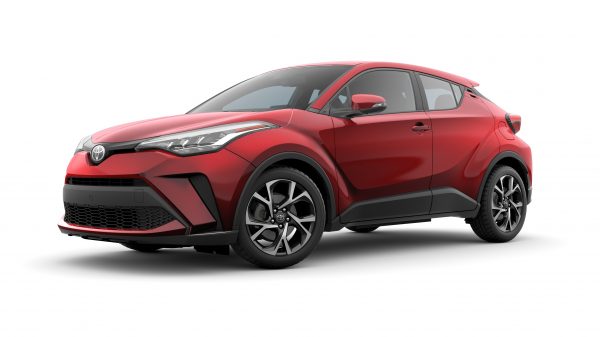
What happens when Toyota designers blend sport coupe, hatchback and compact crossover? The boldly expressive, fun to drive and utterly unique C-HR happens. The C-HR’s standout design brings an updated look for 2020 with a restyled front fascia, LED headlamps and new wheel designs. There’s more pure Toyota value, too, with all three grades – LE, XLE and Limited – adding new amenities.
The Toyota C-HR broke new design ground for the automaker, which applied new manufacturing techniques to take a highly sculpted concept-car body design into production while preserving its essence. The result melds sport coupe personality with crossover versatility.
The C-HR comes equipped with standard Toyota Safety Sense P™ (TSS-P), a multi-feature advanced active safety suite that bundles Pre-Collision System with Pedestrian Detection (PCS w/PD), Lane Departure Alert with Steering Assist (LDA w/SA), Automatic High Beams (AHB), and Full-Speed Range Dynamic Radar Cruise Control (DRCC).
The STAR Safety System comes with: Vehicle Stability Control (VSC), Traction Control (TRAC), Anti-Lock Brake System (ABS), Electronic Brake-Force Distribution (EBD), Brake Assist (BA) and Smart Stop Technology® (SST). Also complementing TSS-P are 10 standard airbags, standard Hill-Start Assist Control (HAC) and a rear backup camera. Blind Spot Monitor with Rear Cross Traffic Alert is standard on the XLE and Limited models.
New Look, New Features, Same Audacious Attitude
The C-HR packs a lot of attitude in a compact package that measures 172.6 in. long on a 103.9- in. wheelbase – making the C-HR a tight, agile form that’s a joy to wheel through congested urban areas.
Never one to blend in, the C-HR updates its extroverted style for 2020 with a redesigned front fascia, headlamps, bumper, grille and spoiler. The LE grade joins its siblings with standard LED headlamps and also debuts a new optional 17-inch alloy wheel design. The Limited grade gets a new 18-inch alloy wheel design.
Added features enhance value for 2020. All C-HR models already came equipped with Apple CarPlay compatibility and now, for 2020, standard Android Auto compatibility completes the smartphone compatible suite. In addition, the LE grade picks up SiriusXM® All Access 3-Month Trial Satellite Radio, which was already standard on XLE and Limited.
The XLE grade adds new seatback pockets and windshield visor extensions, the kind of detail upgrades that owners appreciate in everyday usage. The top-of-line Limited, which already includes leather-trimmed seating, heated front seats and ambient lighting, reaches further into luxury territory with a new 8-way power driver’s seat and Adaptive Front Lighting System (AFS) with headlamp auto-leveling. AFS partially aims the headlight beams into turns as the driver steers, helping to provide an extra margin of night driving safety.
Turns Heads in Every Crowd
Toyota designers went all-in on expressiveness with the C-HR. The slim LED headlights wrap deeply into the sides of the hood, running rearward along the fender tops. Deep, curvy character lines emerge from a prominent Toyota badge on the front fascia and lead into the narrower core body. These lines continue below the side windows and above the rear wheel, where they join a high beltline and distinctive C-pillar with hidden-type design door handles.
The sport coupe persona is especially evident in the fastback-style roof, highly sculpted “wide body” rear quarter panels, and a lip spoiler on the hatchback. At the roof’s edge, a color-matched cantilevered wing tapers neatly inboard.
Canards on the rear quarter panels, front and rear spats, a streamlined rear lower bumper, and stabilizing fins integrated into the taillights all manage critical airflow in and around the body. Beneath the body, a bevy of rigid covers – on the engine, floor, fuel tank, and aft of the rear wheels – cull turbulence and, in doing so, help enhance vehicle control and fuel efficiency.
The C-HR’s color palette is as expressive as the design. Color choices include Blizzard Pearl*, Blue Eclipse Metallic, Magnetic Gray Metallic, Black Sand Pearl, and Silver Knockout Metallic. New for 2020, Supersonic Red* and Hot Lava* (orange), which is available only with the R-Code Black roof. R-Code Black is also available with Silver Knockout Metallic, Blizzard Pearl* and Supersonic Red*, The R-Code White roof is discontinued for 2020 and is replaced with the new R-Code Silver roof* for Black Sand Pearl. With either R-Code option, the roof color is matched by the side mirrors and A-pillars for a truly custom look.
*Extra Cost Color
“MeZONE” Cabin
Toyota designers gave the C-HR a modern and uncluttered interior with a bold placement of accents and a driver-centric orientation. They call it “MeZONE,” but it’s hardly selfish at all. It means fun for the driver and welcoming for passengers.
Along with the soft-touch materials covering surfaces throughout, additional updates for 2020 include a new Gray headliner for the LE and Limited grades, plus two new, striking interior color combinations.
The XLE offers a new Blue/Black interior for 2020, featuring a blue instrument panel, center console armrest, seat trim and seat quilting in blue. The Limited grade’s available Black/Brown interior features a brown instrument panel and center console armrest, silver instrument panel trim and diamond perforation seat pattern.
Together with slim A-pillars, the angled dashboard and controls give the driver a clear view of the road and intuitive access to instrumentation. Passengers will appreciate the generous amount of small-item storage space (sculpted in-door pockets) and cup holders (two front cup holders; two front and two rear bottle holders). Designers used scalloped seatbacks, footwell cubbies carved below the front seats, and a chamfered headliner to create a spacious rear seat area. Sound-insulating materials beneath the carpet, headliner, A-pillars, and door trim help to keep the cabin quiet for conversation and music listening.
The 8-inch Toyota Audio display is positioned centrally atop the dash, rather than in it, to help reduce drivers’ eye movements. A bright 4.2-inch color Multi-Information Display (MID) sits between the twin-ring instrument cluster and shows odometer, SPORT and ECO modes, outside temperature, fuel economy and trip information, fuel economy history, G-force monitor, and much more.
Then there’s C-HR’s practical side. It is, after all, part of Toyota’s SUV/crossover family. The 60/40 split rear seat folds flat, and seatback lock releases are positioned at shoulder height, making it easy to fold the seats without bending over. The rear seats are designed so that the seatbelts do not interfere when folding the seats. Compartments below the cargo area deck board, along with a hidden compartment in the cargo area sidewall, can store small items. A standard cargo cover conceals the trunk area.
Making the Grades
The Toyota C-HR exemplifies Toyota value in all three grades. The LE may be the entry model, but one could hardly use that term to describe such standard equipment as dual-zone automatic climate control, power/heated side mirrors with integrated turn signals, LED headlamps and Toyota Audio with 8-inch touchscreen display and 6 speakers. Additional standard features include an array of multimedia perks, such as Android AutoTM Compatibility, Apple CarPlay® Compatibility & Amazon Alexa Compatibility, USB Media Port, Hands-Free Phone Capability, Advanced Voice Recognition and Music Streaming via Bluetooth® Wireless Technology, SiriusXM® with 3-month All Access Trial. Also standard are Connected Services, that includes Safety Connect® with 1-year Trial and Wi-Fi Connect with up to 2 GB within 3-month Trial. Notable Safety Connect features include an Emergency Assistance Button, Enhanced Roadside Assistance, and Stolen Vehicle Locator.
The LE grade’s generous standard equipment roster goes on and on with a tilt/telescopic steering wheel integrating controls for the audio, Multi-Information Display, Bluetooth® hands-free phone, and voice-command; leather-trimmed shift lever with satin-plated shift knob; Sport fabric-trimmed, 6-way adjustable front bucket seats with sport bolsters; 60/40 split fold-flat second-row rear seat with adjustable headrests, and center armrest with 12V power outlet.
The XLE takes it from there, adding 18-inch alloy wheels, leather-wrapped steering wheel and shift knob, auto-folding side mirrors, “Toyota C-HR” puddle lamps, Smart Key with Push Button Start, Blind Spot Monitor + Rear Cross Traffic Alert and an optional Toyota Audio Plus system.
The Limited tops up the luxury and tech with LED fog lamps, piano-black B-pillar trim, heated front seats, 8-way power driver seat adjustment, ambient lighting, chrome window trim, leather-trimmed seats and an optional Toyota Audio Plus system.
Compact Punch, Dynamic Moves
The C-HR’s punchy dual-overhead cam 2.0-liter four-cylinder engine produces 144 horsepower at 6,100 rpm and 139 pound-feet of torque at 3,900 rpm. The engine employs many of Toyota’s latest-generation technologies, including Variable Valve Timing (VVT) and Valvematic valve lift control.
The front-wheel drive C-HR comes standard with the Continuously Variable Transmission with intelligence and Shift mode (CVTi-S). A preload differential helps to distribute torque between the front wheels during low-speed operation to make for easier, composed driving.
Drivers will welcome the powertrain’s well-sorted nature, and they’ll love Sport mode and the simulated 7-speed Sequential Shiftmatic feature. Engaging Sport mode via the multi-information display (MID) increases throttle responsiveness, quickens the CVT’s simulated automatic “step-up” shifts, and maintains high engine speed to enhance acceleration. Pushing the gearshift over to the left while in Drive engages Sequential Shiftmatic, and lets drivers shift simulated gears manually.
On all C-HR grades, the Brake Hold Function is designed to maintain braking force on all four wheels to keep the vehicle stationary when at a full stop. As a result, the vehicle will remain still even if the driver reduces brake pedal pressure. When the driver depresses the accelerator, brake pressure releases, and the vehicle will move forward.
The C-HR has a EPA-estimated MPG of 27 city / 31 highway / 29 combined.
The C-HR is a Smooth Rider, Too
The Toyota C-HR scores high on style points, but it’s also a hit when it comes to driving fun and ride comfort. The Toyota New Global Architecture (TNGA) C-platform is designed with an inherently low center of gravity, high strength, and low weight. Extensive spot welding, gussets, braces, and adhesives at key connection structures provide outstanding structural rigidity, the cornerstones of nimble handling and smooth ride quality.
The MacPherson strut front suspension uses angled strut bearings and a large diameter stabilizer bar to help the C-HR respond quickly and precisely at initial corner turn-in. The sports car-like multi-link rear suspension utilizes a stabilizer bar with urethane upper supports. The material, together with an aluminum-cast upper support housing, aids in the dampers’ absorption efficiency and benefits vehicle agility, ride comfort and cabin quietness.
Column-type Electronic Power Steering (EPS) system gives the C-HR a sporty driving character. The steering returns a light feel at low speeds, while, at higher speeds, drivers will notice stronger feedback for increased confidence. Braking is handled by 11.7-inch front ventilated discs with 11.5-inch rear solid discs.
The 2020 Toyota C-HR comes equipped with Toyota’s Star Safety System, which includes Enhanced Vehicle Stability Control, Traction Control, Electronic Brake-force Distribution, Brake Assist, Anti-lock Braking System, and Smart Stop Technology.
Limited Warranty and Toyota Care
Toyota’s 36-month/36,000 mile basic new-vehicle warranty applies to all components other than normal wear and maintenance items. Additional 60-month warranties cover the powertrain for 60,000 miles and corrosion with no mileage limitation. The C-HR also comes standard with ToyotaCare, a plan covering normal factory-scheduled maintenance for 2 years or 25,000 miles, whichever comes first, and 24-hour roadside assistance for two years, unlimited mileage.