
Blog / New Vehicles

2019 Toyota Camry Builds on Exciting Style, Sport Performance, and Innovative Safety Tech with More Standard Equipment
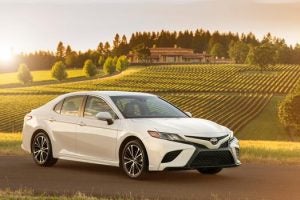
The 2019 Toyota Camry, the best-selling car in America for the past 16 years, continues to build on its already thrilling style, performance, and innovative safety and technology. The continued excitement over the eighth-generation sedan is the result of its total evolution that first debuted last model year, from a proven, dependable and safe car to one that adds a more exciting and emotional character, thanks to its much talked about newfound performance and style. The Camry continues to utilize TNGA (Toyota New Global Architecture), which represents a completely new strategy to the way the company designs, engineers, and packages its vehicles. TNGA retains all of Toyota’s traditional values of superlative build quality and safety while injecting a fun driving experience that plays on all the senses. The physical manifestation is the usage of its engine, transmission, and GA-K platform. Design Backstory The Camry development team aimed for a styling design concept that achieves strong harmony between refinement and a sensual athletic image, creating a new approach to the market. The result is a signature design language that takes the car into a beautiful and futuristic new direction. There were three primary design goals when penning the Camry: a distinctive, low center of gravity that results in a firm wide stance; a practical-yet-emotionally styled cabin profile, and a sporty and upscale image both inside and out. These design goals have resulted in a type of sedan that’s both exciting to look at and, more importantly drive, reestablishing itself as the standard in the mid-size sedan category. An Exterior with Unexpected Attitude The Camry’s face is accentuated by a two-piece grille comprised of flowing thin and thick treatments – key elements of the Camry’s “Keen Look” design philosophy. The curvaceous 1.6-inch-lower aluminum hood sits neatly above the grille’s uppermost section which accommodates a commanding Toyota emblem. For the hybrid model, the emblem is tinged a distinct blue hue. This fashionable trifecta of grille, hood, and emblem blends flawlessly into the A-pillar, and produces a stance that is undoubtedly more aggressive than that of any predecessor. The 2019 Camry has an unchanged exterior. By lowering the hip points of the occupants over the previous generation (0.8-inches in the front and 1.2-inches at the rear), and therefore their seating positions, the design team was able to reduce the car’s overall vehicle height by approximately one inch and incorporate a lower roofline, without sacrificing interior space. This invited the designers to pursue a wind-cutting shape and improve aerodynamics. Striking character lines around and along the body augment the aggressive front and rear fenders, giving the reimagined Camry a sportiness that it’s never had. The hip point, shoulder line, roof line and hood height gives the Camry the appearance that it has a low center of gravity, which it does. The design team took full advantage of the TNGA platform’s versatility to create a very expressive sedan. They penned ground-hugging lines, and formed an energetic silhouette. Their efforts enhanced the Camry’s stance, which is now striking at all angles. Like the front, the rear features an athletic motif that melds flowing lines and complex shapes to form a sculpted landscape. Looking closely at the C-pillar’s detail reveals a multitude of surfaces that reflect light from all angles. A distinct crease extends from the slim multicolor taillights down to the bumper, effectively “pushing” the wheels outward in appearance to create a wide posture akin to that of a premium sports sedan. The exclamation point here is provided by the “C A M R Y” badge that gives the car an upscale identity. Camry is available in five grades: L, LE, XLE, SE, and XSE. The sportier SE and XSE grades wear a noticeably different body style than the entry level L and LE, and premium XLE grades, highlighted by a sculpted rocker panel, 19-inch black machined-finish alloy wheels (standard on XSE) a subtle rear spoiler lip, aggressive front bumper, and rear bumper with a lower diffuser. The face is much more distinctive with large side intakes flanking the lower bumper’s unique “Catamaran-inspired” accents, a high and slim upper intake encompassing the central Toyota badge, and a powerfully expressive gloss black mesh grille. A unique rear bumper with distinctive corner lines highlight the changes at the rear. Smoke-tinted rear combination lamps are available on the XSE grade. Designers sought to make the Camry sport grades instantly recognizable and appear different from the other models from as far as 200 yards away. Click here to read the full article.
Posted in:

Related Posts

First-Ever Toyota Avalon XSE Hybrid Nightshade Edition Highlights Changes for 2022

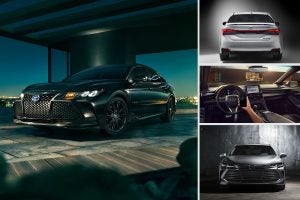
The 2022 Avalon is Toyota’s take on full-size refinement and style. With striking, coupe-inspired design, a spacious, luxury interior, and Toyota Safety Sense 2.5+ (TSS-2.5+) standard on all grades, the 2022 Avalon offers drivers the comfort, quality, and safety they expect from a premium sedan. This year, the XSE Hybrid Nightshade Edition joins the Avalon family. For 2022, Avalon features six configurations across its Hybrid and V6 powertrains. Configurations include XLE, Limited, Touring, XLE Hybrid, XSE Hybrid Nightshade, and Limited Hybrid. With a choice of a silken yet spirited 301-horsepower V6 or a hybrid electric powertrain that achieves an EPA estimated 44 miles per gallon (XLE Hybrid grade), drivers can choose the powertrain that fits their needs. Since the model was launched in 1994, the Toyota Avalon has brought a balance of luxury and safety. For 2022, the entire Avalon lineup moves to TSS 2.5+, which adds Road Sign Assist and Lane Tracing Assist to the active safety system. The Limited, Limited Hybrid and Touring models offer an Advanced Safety Package that includes Bird’s Eye View Camera with Perimeter Scan and Intelligent Clearance Sonar with Rear Cross-Traffic Braking. Toyota’s Rear Seat Reminder is now standard on all 2022 Avalons. The feature notes whether a rear door was opened within 10 minutes of the vehicle being turned on, or at any time after the vehicle has been turned on, with a reminder message in the instrument cluster after the engine is turned off, accompanied by multitone chimes. Click here to read the full article.

Get top dollar for your vehicle at Passport Toyota

We want to buy your vehicle! Get top dollar for your vehicle. All makes and models are needed. Click Here To Get A Real-Time Offer For Your Car In Seconds Get Your Offer Give us a few vehicle details and we’ll send you a real, cash offer in a second Bring It To Us Bring in your offer and your vehicle. After a quick, on-site review of the vehicle, we’ll cut you a check. Get Paid or Upgrade If you’re looking to upgrade you can use your cash offer to trade for a new ride. Your choice - cash or keys to a new car!

Toyota Mirai Sets GUINNESS WORLD RECORDS™ Title with 845 Mile Zero Emission Journey

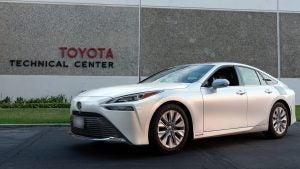
The 2021 Toyota Mirai has officially set the GUINNESS WORLD RECORDS title for the longest distance by a hydrogen fuel cell electric vehicle without refueling. The Mirai achieved an unprecedented 845 miles driven on a single, five-minute complete fill of hydrogen during a roundtrip tour of Southern California as it set the record. Recently selected by Ward’s Automotive as a 10Best Engine & Propulsion Systems winner, the Toyota Mirai’s record sets a new distance milestone for zero emission vehicles. “In 2016, the Toyota Mirai was the first production fuel cell electric vehicle available for retail sale in North America, and now the next generation Mirai is setting distance records,” said Bob Carter, executive vice president, Toyota Motor North America. “We are proud to be leaders of this exciting technology, which is just one of a growing lineup of zero emission vehicles in our portfolio.” more The official record attempt was closely monitored by Guinness World Records, adhering to its strict rules and documentation procedures. On its efficiency-focused August 23 and 24, 2021 journey, the Mirai logged an impressive 152 MPGe with water as its only emission. GUINNESS WORLD RECORDS adjudicator, Michael Empric, validated the Mirai’s tank with a seal at both the beginning and end of the journey. Driven by professional hypermiler, Wayne Gerdes and co-piloted by Bob Winger, the two-day trip began on Monday, August 23, 2021, at the Toyota Technical Center (TTC) in Gardena, California, home of Toyota’s fuel cell development group. The duo traveled south to San Ysidro and then north to Santa Barbara cruising through Santa Monica and Malibu beach along the Pacific Coast Highway. They returned to TTC that evening and logged 473 miles with only two driver swaps that day. The next day, August 24, 2021, consisted of more local driving loops, where they pushed through 372 more miles of morning and afternoon rush hour traffic on the San Diego freeway between Los Angeles and Orange County until the Mirai had no more hydrogen left and coasted into TTC with a grand total of 845 miles driven, as witnessed by Empric. “As a GUINNESS WORLD RECORDS adjudicator for 10 years, I’ve had the opportunity to witness incredible attempts, including several distance-related feats,” said Empric. “The Toyota Mirai’s journey without the need to refuel showcases the power of fuel cell electric technology. This technology and the design ingenuity by the team at Toyota led to a history-making moment.” By the end of the trip, the Mirai consumed a total of 5.65kg of hydrogen and passed a total of 12 hydrogen stations along the drive routes without refueling. The Mirai was driven mainly during rush hour traffic in temperatures between 65 to 83 degrees Fahrenheit. It emitted zero pounds of CO2, where a standard internal combustion engine vehicle would have emitted about 664 lbs. of CO2 over the same distance. The landmark results were achieved by drivers skilled in hypermiling techniques that optimized the Mirai’s vehicle performance under specific weather and driving conditions. They also leveraged some basic fuel-efficient driving tips that any driver can practice. MAINTENANCE & PREPARATION: • Keep up on all scheduled maintenance. A poorly tuned engine will burn more fuel, which can impact fuel economy. (FUN FACT: The 2021 Mirai comes with extended ToyotaCare coverage – a scheduled maintenance plan for 3 years or 35,000 miles!) • Ensure proper wheel alignment. • Check tire pressure, under-inflated tires can lower fuel economy. • Remove cargo or cargo racks to reduce weight. DRIVING TECHNIQUES: • Avoid quick acceleration or heavy braking. • Avoid driving at higher speeds. • Minimize running mechanical and electrical accessories i.e. air conditioner. (FUN FACT: The 2021 Mirai has Drive Mode Select, which offers an ECO mode to prioritize efficiency by optimizing air conditioning operation. Additionally, as on Toyota Hybrids, Predictive Efficient Drive can learn repeatedly traveled routes to optimize charging and discharging of the battery to help maximize fuel economy and driving range.)