



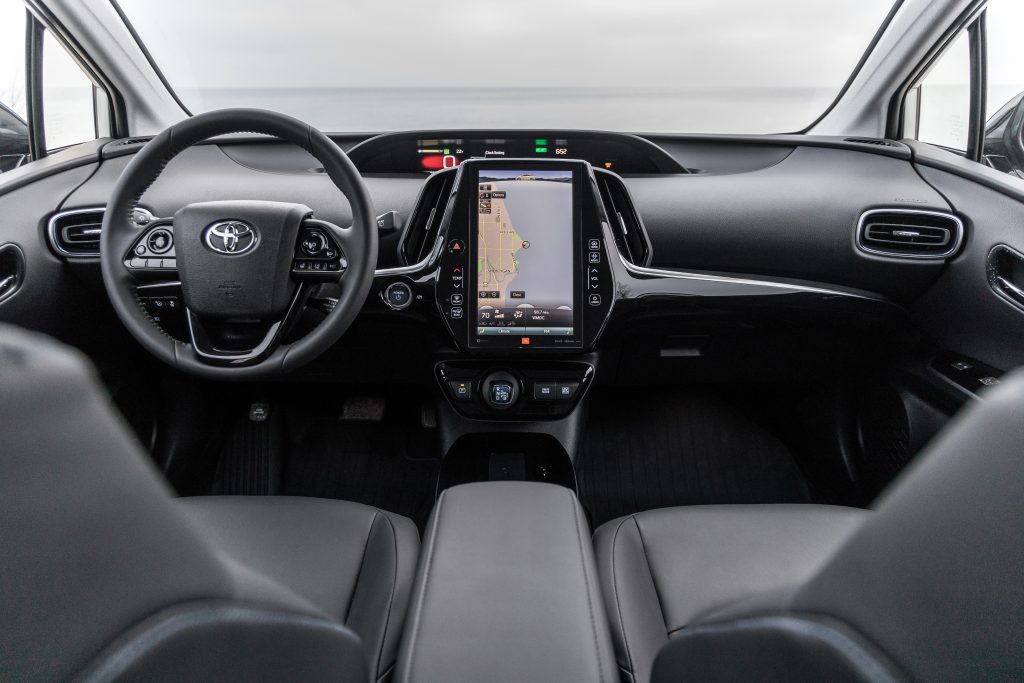
 If the 2020 Toyota Prius could talk, it might congratulate other carmakers for following its lead and offering more gas/electric hybrids. The more hybrids made, the less fuel used and the lower carbon emissions. The Prius, though, in all humility, would also point out that it was the world’s first mass-produced hybrid model more than 20 years ago, that it is one of the world’s best-selling hybrids and that Toyota produces more hybrid models than any other carmaker in the United States.
Then the Prius would highlight its 58 city / 53 highway/56 combined EPA-estimated mpg (L Eco grade). It would show family pictures, of course, including its segment-exclusive AWD-e model, which features an electronic all-wheel drive system which, at speeds up to 43mph, helps give drivers more control when weather and road conditions are less than ideal.
Prius would finish the conversation by emphasizing that all 2020 models now come equipped with standard Toyota Safety Connect and upgraded audio with Apple CarPlay® and Amazon Alexa compatibility. Previously, Safety Connect was available only on the top-line Limited grade. The system, which includes Emergency Assistance, Stolen Vehicle Locator, Roadside Assistance and Automatic Collision Notification, comes with a complimentary three-year trial subscription.
TNGA Means High Strength, Low Weight
The fourth-generation Prius is built around the Toyota New Global Architecture (TNGA), a platform that integrates a high-strength body structure, multi-link rear suspension and a low center of gravity. TNGA endows Prius with a highly engaging driving character combined with exemplary ride smoothness and a quiet cabin.
Hot-stamped and high tensile steels, which allow for intricate forms that are both lightweight and strong, are used extensively throughout the body. Aluminum components, including the hood, rear doorframes, and brake calipers, help keep vehicle weight low. Innovative fastening methods, including laser screw welding and advanced adhesives, contribute to structural strength.
How Prius Operates
The current, fourth-generation Prius continues to be a leader in the hybrid world. Its Hybrid Synergy Drive system combines the output of a 1.8-liter 4-cylinder gasoline engine and two motor-generators through an electronically controlled planetary-type continuously variable transmission (CVT).
The Electronically Controlled Brake System coordinates control between the regenerative braking and the vehicle’s hydraulic brake force to provide brake performance. The gasoline engine is itself a paragon of high efficiency. Thanks to ultra-low internal friction and efficient combustion, it exceeds 40 percent thermal efficiency, which is among the highest in the world for a gasoline engine.
The front-wheel-drive (FWD) Prius is a real fuel miser. The L Eco grade has 58 mpg city / 53 mpg highway / 56 mpg combined EPA-estimated fuel economy. The LE, XLE and Limited, which offer more equipment, have 54 mpg city / 50 mpg highway / 52 mpg combined.
The Prius front-wheel drive models use a lithium ion battery, while the AWD-e versions employ a nickel-metal hydride (Ni-MH) battery. The latter technology is inherently resilient to extreme temperature change to provide AWD-e models with excellent battery performance in cold-weather conditions. Speaking of cold weather, the XLE grade (both FWD and AWD-e) features upgraded SofTex®-trimmed, heated front seats as standard.
A Design that Just Works
Every facet of the Prius contributes to its stellar fuel economy. The Prius design slips through the air with minimal wind resistance, thanks to an ultra-low 0.24 coefficient of drag (Cd), which is among the lowest of current production passenger cars. An automatic grille shutter reduces aerodynamic drag by closing when airflow to the radiator is not needed. Even the air conditioning system, which uses a quiet electric compressor, works intelligently to maximize energy efficiency. While ensuring passenger comfort, the Smart-flow (S-FLOW) mode directs airflow only to seated occupants to conserve energy.
Standard Bi-LED headlamps and LED rear combination lamps not only provide better light than halogens, but they also reduce energy consumption and give a longer service life. A full-width glass panel beneath the rear spoiler aids rearward visibility while also serving as a distinctive Prius design feature. A backup camera comes standard on all grades, as well.
In addition to exceptional fuel efficiency, something else all Prius models share in common is outstanding versatility. The front-wheel drive models offer up to 65.5 cu. ft. of cargo space with the rear seatbacks folded down, which is more than in some small SUVs. The Prius AWD-e models offer 62.7 cu. ft. of space, the small difference due to accommodating the AWD-e system.
Expanding carrying options, the Prius models offer available Genuine Toyota Accessory cargo crossbars for roof rack attachments, such as for carrying bikes, kayaks, snowboards, or a cargo carrier.
AWD-e Electrifies Traction
In 2019, Toyota introduced the Prius AWD-e, the first-ever Prius with all-wheel drive. While enhancing traction for drivers, the Prius AWD-e upholds the model’s penchant for outstanding efficiency, with 52 mpg city / 48 mpg highway / 50 mpg combined EPA fuel economy estimates. That easily makes Prius AWD-e one of the most fuel-efficient all-wheel-drive-equipped passenger cars available in the U.S.
The “e” in AWD-e is the key to offering the extra grip of all-wheel drive while still sipping fuel. The automatic, on-demand system does not require a center differential or other torque-apportioning device, nor does it need a front-to-rear driveshaft. Instead, the “e” in AWD-e stands for electronic.
An independent electric, magnet-less rear motor (a Toyota first) powers the rear wheels away from a stop up to 6 mph, and then, when conditions demand, at speeds up to 43 mph. By recognizing when all-wheel-drive is not needed, this intelligent on-demand system runs in front-wheel drive as much as possible to maximize fuel economy.
Click here to read the full article.
![[Facebook]](https://www.passporttoyota.com/blogs/716/wp-content/plugins/bookmarkify/facebook.png)
![[LinkedIn]](https://www.passporttoyota.com/blogs/716/wp-content/plugins/bookmarkify/linkedin.png)
![[Twitter]](https://www.passporttoyota.com/blogs/716/wp-content/plugins/bookmarkify/twitter.png)
![[Yahoo!]](https://www.passporttoyota.com/blogs/716/wp-content/plugins/bookmarkify/yahoo.png)
![[Email]](https://www.passporttoyota.com/blogs/716/wp-content/plugins/bookmarkify/email.png)
Connect with us


