5 Tips to Help You Keep Your Cool in D.C. Traffic
Just as you gear up to fight off the winter chill, it's also important to make plans to protect your car against the elements. Implementing a little planning and acting on these simple steps can extend the life and looks of your vehicle, in the wintertime and beyond. Cover Up It may be convenient, but leaving your car outside to soak up the sun, wind, and rain can dull a paint job over time. If you have access to a garage or carport, don't be lazy and just leave it in the driveway. Go ahead and pull the car in the garage to park. You'll thank yourself when you don't have to shovel snow and ice to dig your car out when the weather takes a turn for the worse. more Protection Matters You can protect your car's "skin" just the same as you would your own--by applying a little balm. Car wax and paint sealants applied over the car's surface imparts a nice luster while also protecting the paint job from corrosive road salts and dirty snow melt. Don't forget about your tires. Keep wheel corrosion at bay with wheel coating and an application of tire gel will prevent tires from cracking in the cold. Scrape Carefully Use the right tools for the season, such as a snow brush with soft bristles, and be wary of scraping a windshield scraper across paint surfaces, as it may cause damage. In addition, using a windshield wiper fluid that was formulated for wintertime will help keep moisture from freezing. You can also make sure to dust snow and ice off of the hood when you exit the car so that melting run-off won't freeze on the windshield. Pull your wipers up off of the surface to keep them from freezing to the surface so your scraping isn't such a chore. Clean Up One of the best things you can do to prevent corrosion is to wash your vehicle frequently. You can do this at home, but many people prefer to take their car to a car wash or detailer in the winter months to clean even hard to reach places, like the undercarriage and behind mudflaps. Try to wash your car earlier in the day so there will be time for it to dry without water refreezing on the car. Also, beware of washing in very low temperatures, lest your doors and locks freeze shut. The Inside Counts Don't neglect the interior of your car. One surprising place that breeds corrosion is underfoot, beneath your snowy boots. Melting, dirty snow carries road salt which can soak the vehicle floor mats and sink through to the undercarriage, eventually causing rust. It's a good idea to invest in fitted plastic floor mats that will easily wipe clean with a towel. Keep your car clean inside and out in the winter months. If you are vigilant about washing your car and protecting its surfaces, you'll also protect your car's beauty and structural integrity in all seasons. You can also protect your car's "skin" just the same as you would your own, by applying a little balm. Car wax applied over the surface of the car will not only impart an attractive glow, but will also protect the paint job from corrosive road salts and dirty snow melt. Photo by John Morton | Licensed under cc BY-SA 2.0
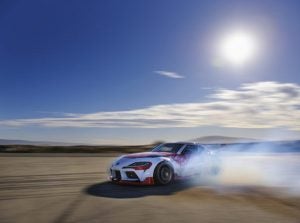
What if every driver who ran into trouble had the instinctive reflexes of a professional race car driver and the calculated foresight of a supercomputer to avoid a crash? Researchers at Toyota Research Institute are working with Stanford’s Dynamic Design Lab to make this vision come true. The engineers are conducting research into how to bring together the instincts of professional drivers and automated driving technology. Their goal is to design a new level of active safety technology and share it broadly so that Toyota and other auto manufacturers can deploy it on the road. “Every day, there are deadly vehicle crashes that result from extreme situations where most drivers would need superhuman skills to avoid a collision,” said Gill Pratt, TRI CEO and Chief Scientist at Toyota Motor Corporation (TMC). “The reality is that every driver has vulnerabilities, and to avoid a crash, drivers often need to make maneuvers that are beyond their abilities. Through this project, TRI will learn from some of the most skilled drivers in the world to develop sophisticated control algorithms that amplify human driving abilities and keep people safe. This is the essence of the Toyota Guardian™ approach.” more Every year, car crashes result in nearly 40,000 fatalities in the United States, and about 1.25 million fatalities worldwide. Toyota’s goal is to reduce that number to zero. While most crashes occur in mundane situations, in other situations drivers may need to make maneuvers that take their vehicle close to and, at times, exceed normal limits of handling. When faced with wet or slippery roads for instance, professional drivers may choose to ‘drift’ the car through a turn. “Since 2008, our lab has taken inspiration from human race car drivers in designing algorithms that enable automated vehicles to handle the most challenging emergencies,” said Professor Chris Gerdes of Stanford University’s Dynamic Design Laboratory. “Through this research, we have the opportunity to move these ideas much closer to saving lives on the road.” TRI has supported the Dynamic Design Lab’s research for many years. The current project draws upon Stanford’s published paper, “Opening New Dimensions: Vehicle Motion Planning and Control using Brakes while Drifting,” in which Stanford researchers demonstrated advanced drifting on MARTY, an electrified, automated DeLorean. Stanford’s experimental results produced a proof-of-concept architecture capable of controlling a rear-wheel drive vehicle in a drift using brakes, steering and propulsion. TRI is now applying this architecture to vehicle platforms, including the GR Supra. TRI is also engaging Toyota’s engineering expertise in motorsports and advanced development. Toyota Racing Development (TRD U.S.A., Inc.) in the United States is providing valuable technical and experiential know-how in motorsports and drifting. Separately, TRI is also working with Toyota Motor Corporation’s Vehicle Dynamics Control Team — based in Japan — to apply the drifting architecture for future Toyota vehicles.